154303-05-6
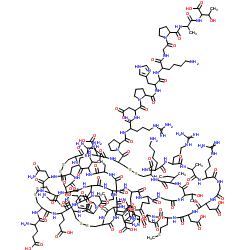
154303-05-6 structure
- Name: Echistatin
- Chemical Name: Echistatin, α1 isoforM
- CAS Number: 154303-05-6
- Molecular Formula: C217H341N71O74S9
- Molecular Weight: 5417.0
- Catalog: Signaling Pathways Cytoskeleton Integrin
- Create Date: 2018-07-07 08:56:36
- Modify Date: 2026-06-30 08:25:17
-
Echistatin, the smallest active RGD protein belonging to the family of disintegrins that are derived from snake venoms, is a potent inhibitor of platelet aggregation. Echistatin is a potent inhibitor of bone resorption in culture. Echistatin is a potent antagonist of αIIbβ3, αvβ3 and α5β1[1][2][3][4].
| Name | Echistatin, α1 isoforM |
|---|---|
| Synonyms |
Echistatin,α1 isoform,TFA salt
H-Glu-Cys-Glu-Ser-Gly-Pro-Cys-Cys-g-Asn-Cys-Lys-Phe-Leu-Lys-Glu-Gly-Thr-Ile-Cys-Lys-g-Ala-g-Gly-Asp-Asp-Met-Asp-Asp-Tyr-Cys-Asn-Gly-Lys-Thr-Cys-Asp-Cys-Pro-g-Asn-Pro-His-Lys-Gly-Pro-Ala-Thr-OH Echistatin α1 H-Glu-Cys-Glu-Ser-Gly-Pro-Cys-Cys-g-Asn-Cys-Lys-Phe-Leu-Lys-Glu-Gly-Thr-Ile-Cys-Lys-g-Ala-g-Gly-Asp-Asp-Met-Asp-Asp-Tyr-Cys-Asn-Gly-Lys-Thr-Cys-Asp-Cys-Pro-g-Asn-Pro-His-Lys-Gly-Pro-Ala-Thr-OH(Disulfide bridge:Cys2-Cys11 ECHISTATIN,A1 ISOFORM Cys8-Cys37 Cys7-Cys32 C217H341N71O74S9 (Disulfide bonds between Cys2 and Cys11/Cys7 and Cys32/ Cys8 and Cys37/Cys20 and Cys39) Cys20-Cys39) Echistatin, α1 isoform |
| Description | Echistatin, the smallest active RGD protein belonging to the family of disintegrins that are derived from snake venoms, is a potent inhibitor of platelet aggregation. Echistatin is a potent inhibitor of bone resorption in culture. Echistatin is a potent antagonist of αIIbβ3, αvβ3 and α5β1[1][2][3][4]. |
|---|---|
| Related Catalog | |
| Target |
αvβ3 α5β1 αIIbβ3 |
| References |
| Molecular Formula | C217H341N71O74S9 |
|---|---|
| Molecular Weight | 5417.0 |
| Hazard Codes | Xi |
|---|---|
| RIDADR | NONH for all modes of transport |