9004-61-9
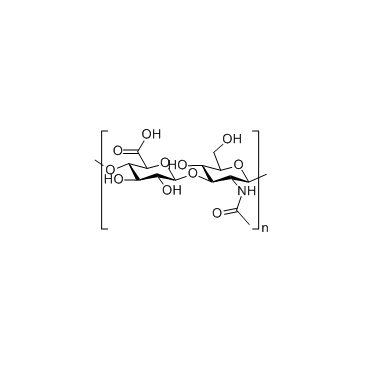
9004-61-9 structure
- Name: Hyaluronic acid
- Chemical Name: hyaluronic acid
- CAS Number: 9004-61-9
- Molecular Formula: (C14H21NO11)n
- Molecular Weight: 379.32 (monomer)
- Catalog: Biochemical Enzymes and coenzymes
- Create Date: 2018-09-16 18:09:27
- Modify Date: 2026-06-30 11:42:03
-
Hyaluronic acid is a biopolymer composed of repeating units of disaccharides with various applications.
| Name | hyaluronic acid |
|---|---|
| Synonyms |
(4ξ)-α-D-xylo-hexopyranuronosyl-(1->;3)-2-(acetylamino)-2-deoxy-β-D-glucopyranosyl-(1->4)-(5ξ)-β-D-xylo-hexopyranuronosyl-(1->;3)-2-(acetylamino)-2-deoxy-D-glucopyranose
Cationized Hyaluronate HYALURONIC ACID (SODIUM HYALURONATE) Hyaluronic Acid Sodium Salt Hyaluronic acid (hyaluronan sodiuM (2S,3S,4R,5R,6R)-3-((2S,3R,5S,6R)-3-acetaMido-5-hydroxy-6-(hydroxyMethyl)tetrahydro-2H-pyran-2-yloxy)-4,5,6-trihydroxytetrahydro-2H-pyran-2-cboxylate Hydluronic acid hyaluronic acid(9-9) Hyaluronic acid( medical ade ) Sodium Hyaluronate MMW hyaluronicaci aluronic acid、HA HYALURONIC ACID HUMAN SODIUM SALT Chlamyhyaluronic acid Food ade hyaluronic acid Hyaluronic acid, bovine vitreous humor soluble Sodium Hyaluronate Powder (4ξ)-α-D-xylo-Hexopyranuronosyl-(1->;3)-2-acetamido-2-deoxy-β-D-allopyranosyl-(1->4)-(5ξ)-β-D-xylo-hexopyranuronosyl-(1->3)-2-acetamido-2-deoxy-D-glucopyranose hyaluronic acid from bovine vitreous humor HA,hyaluronic acid hyaluronic acid/hyaluronic acid sodium Hyaluronic Acid, from Human Umbilical Cords Hyaluronate Acid [BETA-SODIUM-GLUCONATE-(1,3)-BETA-N-ACETYL-D-GLUCOSAMINE-1,4-]N HYALURONIC ACID INJECTION ADE SODIUM HYALURONATE (STRTOCOCCUS) disodium 3-[3-acetamido-4-(6-cboxylato-3,4,5-trihydroxy-oxan-2-yl)oxy-5-hydroxy-6-(hydroxymethyl)oxan-2-yl]oxy-6-[3-acetamido-2,5-dihydroxy-6-(hydroxymethyl)oxan-4-yl]oxy-4,5-dihydroxy-oxane-2-cboxylate HYALURONICACID(HA)(BULK HYALURONIC ACID NA-SALT Hyaluronic acid //BP hyaluronate sodium DP2 HYALURONIC ACID - INJECTABLE ADE Cosmetic HA hyaluronic Acid Powder hyaluronate sodium DP4 HYALURONIC ACID SODIUM HYALURONIC ACID FOOD ADE (VIA EXTRACTION) MFCD00131348 Hyalobrier gel hyaluronate sodium DP6 Hyaluronic Acid Food /Cosmetic ade /Injection Min hyaluronate sodium DP8 EINECS 232-678-0 Hyaluronic acid from Cockscomb Hyaluronic Acid from Bovine Vitreous Humor [Substrate for Hyaluronidase] HYALURONIC ACID, SODIUM SALT, STRTOCOCCUS SPECIES Sracoat Hyaluronic acid powder Sodium Hyaluronate Oligo Eye drop ade hyaluronic acid Sodium Hyaluronate HMW sodium 3-[[3-acetamido-5-hydroxy-6-(hydroxymethyl)-2-oxanyl]oxy]-4,5,6-trihydroxy-2-oxanecboxylate HYALURONIC ACID - PHMA ADE COPOLY(BETA-GLUCURONIC ACID-[1-]-BETA-N-ACETYLGLUCOSAMINE-[1-] SODIUM SALT HYALURONIC ACID - FOOD ADE POLY(BETA-GLUCURONIC ACID-[1-]-BETA-N-ACETYLGLUCOSAMINE-[1-]), ALTERNATING hyaluronic acid sodium from*strtococcus zooid Haluronic acid、HA Sodium Hyaluronate of LM Mucoitin acid hyaluronic Hyaluronicacid acid ,HA |
| Description | Hyaluronic acid is a biopolymer composed of repeating units of disaccharides with various applications. |
|---|---|
| Related Catalog | |
| Target |
Human Endogenous Metabolite |
| In Vitro | Hyaluronic acid (HA) is widely used in aesthetic medicine due to its binding ability with a large number of water molecules. It improves tissue hydration and their resistance to mechanical damage. HA plays an important role in wound healing, ovulation, fertilization, signal transduction, and tumor physiology. HA is used in joint diseases such as osteoarthritis or rheumatoid arthritis. HA of a high molecular mass reduces the chemotaxis and migration of inflammatory cells which acts as a good barrier to the inflammatory process and protects against the effects of free radicals. HA is used in ophthalmology due to its lubricating properties for the corneal endothelium, and improves tissue hydration and cellular resistance to mechanical damage in aesthetic dermatology, and has marginal adverse effects. Several trials indicate its role in tumor markers, liver diseases, and in pharmaceuticals[1]. Hyaluronan plays an important role in cancer growth and metastasis. HA and HA fragment-tumor cell interaction could activate the downstream signaling pathways, promoting cell proliferation, adhesion, migration and invasion, and inducing angiogenesis, lymphangiogenesis, epithelial-mesenchymal transition, stem cell-like property, and chemoradioresistance in digestive cancers[2]. |
| In Vivo | The impact of applied intra-articular HA has been proven in many studies in animals. Studies on HA have shown that it promotes the synthesis of cartilage matrix, prevents its degradation, reduces inflammation, stimulates the synthesis of endogenous HA, and improves the resilience and moisture of cartilage [1]. High molecular size HA preparations, applied topically, promote healing of fresh skin wounds. They also promote the healing of venous leg ulcers and are useful in the management of chronic wounds[3]. |
| References |
[2]. Wu RL, et al. Hyaluronic acid in digestive cancers. J Cancer Res Clin Oncol. 2017 Jan;143(1):1-16. |
| Density | 1.8±0.1 g/cm3 |
|---|---|
| Boiling Point | 1274.4±65.0 °C at 760 mmHg |
| Molecular Formula | (C14H21NO11)n |
| Molecular Weight | 379.32 (monomer) |
| Flash Point | 724.5±34.3 °C |
| PSA | 399.71000 |
| LogP | -6.62 |
| Vapour Pressure | 0.0±0.6 mmHg at 25°C |
| Index of Refraction | 1.666 |
| Storage condition | −20°C |
| Water Solubility | H2O: 5 mg/mL, clear, colorless | Soluble in water. |
|
~%
9004-61-9 |
| Literature: US2006/172967 A1, ; Page/Page column 5 ; |
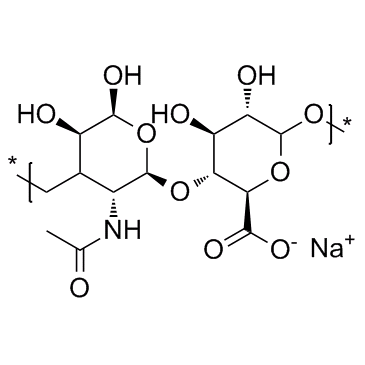
| HS Code | 3004909090 |
|---|