1190006-03-1
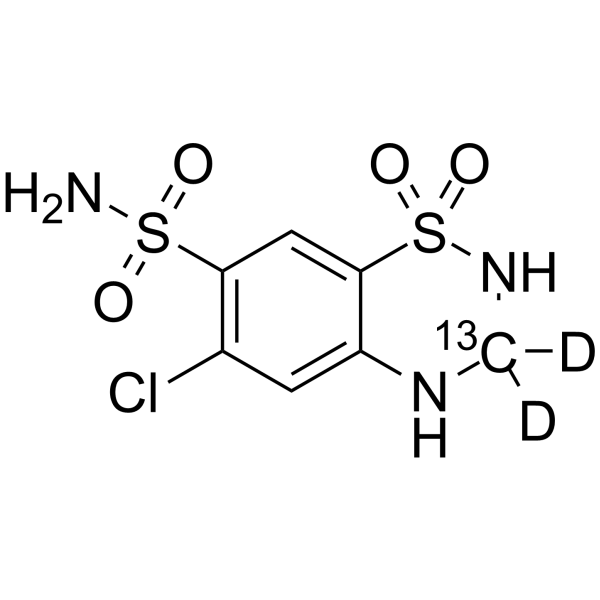
1190006-03-1 structure
- Name: Hydrochlorothiazid-13C,d2
- Chemical Name: 6-chloro-3,3-dideuterio-1,1-dioxo-2,4-dihydro-1λ6,2,4-benzothiadiazine-7-sulfonamide
- CAS Number: 1190006-03-1
- Molecular Formula: C613CH6D2ClN3O4S2
- Molecular Weight: 300.74
- Catalog: Signaling Pathways Membrane Transporter/Ion Channel Potassium Channel
- Create Date: 2017-02-09 06:23:35
- Modify Date: 2026-07-02 14:29:39
-
Hydrochlorothiazid-13C,d2 is the 13C- and deuterium labeled. Hydrochlorothiazide (HCTZ), an orally active diuretic drug of the thiazide class, inhibits transforming TGF-β/Smad signaling pathway. Hydrochlorothiazide has direct vascular relaxant effects via opening of the calcium-activated potassium (KCA) channel. Hydrochlorothiazide improves cardiac function, reduces fibrosis and has antihypertensive effect[1][2][3].
| Name | 6-chloro-3,3-dideuterio-1,1-dioxo-2,4-dihydro-1λ6,2,4-benzothiadiazine-7-sulfonamide |
|---|---|
| Synonyms |
Aquius-13C,d2
BreMil-13C,d2 Aquarius-13C,d2 Dichlotride-13C,d2 Hydrochlorothiazide-13C,d2 13C,-Hydrochlorothiazide Thiuretic-13C,d2 6-Chloro-3,4-dihydro-2H-1,2,4-benzothiadiazine-13C,-7-sulfonamide 1,1-Dioxide Diurizid-13C,d2 Hydrochlorothiazide 13C D2Q: What is Hydrochlorothiazide 13C D2 Q: What is the CAS Number of Hydrochlorothiazide 13C D2 Q: What is the storage condition of Hydrochlorothiazide 13C D2 Q: What e the applications of Hydrochlorothiazide 13C D2 Drenol-13C,d2 6-chloro-3,3-dideuterio-1,1-dioxo-2,4-dihydro-1 l^{6},2,4-benzothiadiazine-7-sulfonamide Bremil-13C,d2 Cidrex-13C,d2 Hydrex-13C,d2 Pantemon-13C,d2 |
| Description | Hydrochlorothiazid-13C,d2 is the 13C- and deuterium labeled. Hydrochlorothiazide (HCTZ), an orally active diuretic drug of the thiazide class, inhibits transforming TGF-β/Smad signaling pathway. Hydrochlorothiazide has direct vascular relaxant effects via opening of the calcium-activated potassium (KCA) channel. Hydrochlorothiazide improves cardiac function, reduces fibrosis and has antihypertensive effect[1][2][3]. |
|---|---|
| Related Catalog | |
| In Vitro | Stable heavy isotopes of hydrogen, carbon, and other elements have been incorporated into drug molecules, largely as tracers for quantitation during the drug development process. Deuteration has gained attention because of its potential to affect the pharmacokinetic and metabolic profiles of drugs[71]. |
| References |
| Molecular Formula | C613CH6D2ClN3O4S2 |
|---|---|
| Molecular Weight | 300.74 |
| Exact Mass | 299.98000 |
| PSA | 135.12000 |
| LogP | 2.97740 |