1256388-51-8
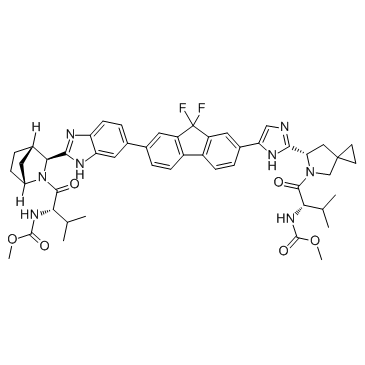
1256388-51-8 structure
- Name: Ledipasvir
- Chemical Name: ledipasvir
- CAS Number: 1256388-51-8
- Molecular Formula: C49H54F2N8O6
- Molecular Weight: 889.000
- Catalog: Biochemical Inhibitor Proteases HCV Protease Inhibitor
- Create Date: 2018-04-01 08:00:00
- Modify Date: 2026-06-30 11:08:20
-
Ledipasvir is an inhibitor of the hepatitis C virus NS5A, with EC50s of 34 pM and 4 pM against genotype 1a and 1b replicon, respectively.
| Name | ledipasvir |
|---|---|
| Synonyms |
Ledipasvir 13C2 D6Q: What is Ledipasvir 13C2 D6 Q: What is the CAS Number of Ledipasvir 13C2 D6 Q: What is the storage condition of Ledipasvir 13C2 D6 Q: What e the applications of Ledipasvir 13C2 D6
Ledipasvir / GS N-[(1S)-1-[[(6S)-6-[5-[9,9-Difluoro-7-[2-[(1R,3S,4S)-2-[(2S)-2-[(methoxycbonyl)amino]-3-methyl-1-oxobutyl]-2-azabicyclo[2.2.1]ht-3-yl]-1H-benzimidazol-6-yl]-9H-fluoren-2-yl]-1H-imidazol-2-yl]-5-azaspi Cbamic acid, N-[(1S)-1-[[(6S)-6-[5-[9,9-difluoro-7-[2-[(1R,3S,4S)-2-[(2S)-2-[(methoxycbonyl)amino]-3-methyl-1-oxobutyl]-2-azabicyclo[2.2.1]ht-3-yl]-1H-benzimidazol-6-yl]-9H-fluoren-2-yl]-1H-imidazol-2-yl]-5-azaspiroht-5-yl]carbonyl]-2-methylpropyl]-, methyl ester Ledipasvir HCV NS5A polymerase inhibitor N-[(1S)-1-[[(6S)-6-[5-[9,9-difluoro-7-[2-[(1R,3S,4S)-2-[(2S)-2-[(methoxycbonyl)amino]-3-methyl-1-oxoButyl]-2-azabicyclo[2.2.1]ht-3-yl]-1H-benzimidazol-6-yl]-9H-fluoren-2-yl]-1H-imidazol-2-yl]-5-azaspiroht-5-yl]carbonyl]-2-methylpropyl]-cbamic Ledipasvir, 5A of hatitis C virus inhibitor Ledipasvir (10mM in DMSO) Ledipasvir undefined salt form Ledipasvir (API, Amorphous) UNII-013TE6E4WV N-[(1S)-1-[[(6S)-6-[5-[9,9-difluoro-7-[2-[(1R,3S,4S)-2-[(2S)-2-[(methoxycbonyl)amino]-3-methyl-1-oxobutyl]-2-azabicyclo[2.2.1]ht-3-yl]-1H-benzimidazol-6-yl]-9H-fluoren-2-yl]-1H-imidazol-2-yl]-5-azaspiroht-5-yl]carbonyl]-2-methylpropyl]-cbamic acid methyl ester 332-7 methyl((S)-1-((S)-6-(5-(9,9-difluoro-7-(2-((1R,3S,4S)-2-((methoxycbonyl)-L-valyl)-2-azabicyclo[2.2.1]htan-3-yl)-1H-benzo[d]imidazol-6-yl)-9H-fluoren-2-yl)-1H-imidazol-2-yl)-5-azaspirohtan-5-yl)-3-methyl-1-oxobutan-2-yl)cbamate GS5885 Ledipasvir: copovidone solid dispersion 1:1 GS-5885/Ledipasvir Ledipasvir API Carbamic acid, N-[(1S)-1-[[(6S)-6-[5-[9,9-difluoro-7-[2-[(1R,3S,4S)-2-[(2S)-2-[(methoxycarbonyl)amino]-3-methyl-1-oxobutyl]-2-azabicyclo[2.2.1]hept-3-yl]-1H-benzimidazol-6-yl]-9H-fluoren-2-yl]-1H-imidazol-2-yl]-5-azaspiro[2.4]hept-5-yl]carbonyl]-2-methylpropyl]-, methyl ester Diave LedipasvirQ: What is Ledipasvir Q: What is the CAS Number of Ledipasvir Q: What is the storage condition of Ledipasvir Q: What e the applications of Ledipasvir Solid dispersion of ledipasvir Leidipawei GS 5885;GS-5885;GS Abmole M2553-50mg GS-5885 1256-8 GS-5885 Ledipasvir D16 Ledipasvir D8Q: What is Ledipasvir D8 Q: What is the CAS Number of Ledipasvir D8 Q: What is the storage condition of Ledipasvir D8 Q: What e the applications of Ledipasvir D8 Methyl [(2S)-1-{(1R,3S,4S)-3-[5-(9,9-difluoro-7-{2-[(6S)-5-{(2S)-2-[(methoxycarbonyl)amino]-3-methylbutanoyl}-5-azaspiro[2.4]hept-6-yl]-1H-imidazol-4-yl}-9H-fluoren-2-yl)-1H-benzimidazol-2-yl]-2-azabicyclo[2.2.1]hept-2-yl}-3-methyl-1-oxo-2-butanyl]carbamate 1H-Pyrazol-5-amine,1-(6-methylethyl) gs-5885/gs5885 |
| Description | Ledipasvir is an inhibitor of the hepatitis C virus NS5A, with EC50s of 34 pM and 4 pM against genotype 1a and 1b replicon, respectively. |
|---|---|
| Related Catalog | |
| Target |
EC50: 34 pM (GT1a), 4 pM (GT1b)[1] |
| In Vitro | Ledipasvir has GT1a and 1b EC50 values of 31 and 4 pM, respectively, and protein-adjusted EC50 values of 210 pM (GT1a) and 27 pM (GT1b) and the intrinsic EC50 of 39 is 310 fM for GT1a and 40 fM for GT1b. Ledipasvir is highly protein-bound both in human serum and in the cell-culture medium (containing 10% BSA) of the replicon assay[1]. Ledipasvir exhibits an EC50 value of 141 nM against the JFH/3a-NS5A replicon[2]. |
| In Vivo | Ledipasvir is remarkable not only on the basis of its high replicon potency but also on the basis of its low clearance, good bioavailability, and long half-lives in rat, dog, and monkey and low predicted clearance in human. The pharmacokinetics of Ledipasvir is measured in rats and dogs. Ledipasvir shows good half-lives (rat 1.83 ± 0.22 hr, dog 2.63 ± 0.18 hr) in plasma, low systemic clearance (CL), and moderate volumes of distribution (Vss) that are greater than total body water volume[1]. |
| Animal Admin | Rats, Dogs and Monkeys[1] Pharmacokinetic studies are performed in male naı̈ve Sprague-Dawley(SD) rats, non-naive beagle dogs, and cynomolgus monkeys (three animals per dosing route). Intravenous (IV) administration is dosed via infusion over 30 min in a vehicle containing 5% ethanol, 20% PEG400, and 75% water (pH adjusted to 3.0 with HCl). Oral dosing is administered by gavage in a vehicle containing 5% ethanol, 45% PEG 400, and 50% of 50 mM citrate buffer, pH 3. Blood samples are collected over a 24 h period postdose into Vacutainer tubes containing EDTA-K2. Plasma was isolated, and the concentration of the test compound in plasma was determined with LC/MS/MS after protein precipitation with acetonitrile. |
| References |
| Density | 1.4±0.1 g/cm3 |
|---|---|
| Molecular Formula | C49H54F2N8O6 |
| Molecular Weight | 889.000 |
| Exact Mass | 888.413452 |
| PSA | 174.64000 |
| LogP | 6.77 |
| Index of Refraction | 1.677 |