30748-29-9
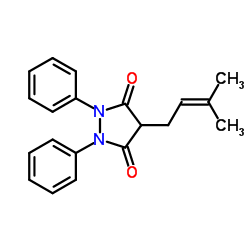
30748-29-9 structure
- Name: feprazone
- Chemical Name: Feprazone
- CAS Number: 30748-29-9
- Molecular Formula: C20H20N2O2
- Molecular Weight: 320.385
- Catalog: API Antipyretic analgesics Non-steroidal anti-inflammatory drugs
- Create Date: 2018-06-11 17:24:22
- Modify Date: 2026-07-02 12:21:32
-
Feprazone (DA2370; Prenazone), an analogue of Phenylbutazone (HY-B0230), is a nonsteroidal anti-inflammatory agent with analgesic and antipyretic activities. Feprazone acts by inhibiting the activity of cyclooxygenase (COX)-2. Feprazone ameliorates free fatty acid (FFA)-induced oxidative stress by reducing the production of mitochondrial reactive oxygen species (ROS). Feprazone can decrease the expression of MMP-2 and MMP-9. Besides, Feprazone can suppress adipogenesis and increase lipolysis in differentiating 3 T3-L1 cells. Feprazone also can be used to research atherosclerosis and obesity[1][2][3].
| Name | Feprazone |
|---|---|
| Synonyms |
1,2-diphenyl-4-(3-methyl-2-butenyl)-3,5-pyrazolidinedione
4-(3-methyl-2-butenyl)-1,2-diphenyl-3,5-pyrazolidinedione da2370 isona Zelin 1,2-diphenyl-4-(3-methyl-2-butenyl)-5-pyrazolidinedione phenylprenazone methrazone Frazone in Acetonitrile MFCD00866063 Frazone //BP 4-Prenyl-1,2-diphenyl-3,5-pyrazolidindion 4-(2-isopentenyl)-1,2-diphenyl-3,5-pyrazolidinedione prenazone Naloven 4-(3-methylbut-2-enyl)-1,2-diphenylpyrazolidine-3,5-dione Frazone, 10 mM in DMSO Prenazone analud 3,5-Pyrazolidinedione, 4-(3-methyl-2-buten-1-yl)-1,2-diphenyl 4-(3-methyl-2-butenyl)-1,2-diphenyl-5-pyrazolidinedione Grisona Metherazone,Prenazone fenilprenazone 4-prenyl-1,2-diphenyl-3,5-dioxopyrazolidine 4-prenyl-1,2-diphenyl-3,5-pyrazolidinedione 4-(beta-isoamylenyl)-1,2-diphenyl-3,5-pyrazolidinedione 4-(3-Methyl-2-buten-1-yl)-1,2-diphenyl-3,5-pyrazolidinedione 4-(3-Methylbut-2-en-1-yl)-1,2-diphenylpyrazolidine-3,5-dione Zepelin EINECS 250-324-3 phrazone 4-(b-Isoamylenyl)-1,2-diphenyl-3,5-pyrazolidinedione 4-(Aminomethyl)cyclohexanecboxylic acid Solution, 100ppm Metherazone Nilatin FRAZONE Tabrien |
| Description | Feprazone (DA2370; Prenazone), an analogue of Phenylbutazone (HY-B0230), is a nonsteroidal anti-inflammatory agent with analgesic and antipyretic activities. Feprazone acts by inhibiting the activity of cyclooxygenase (COX)-2. Feprazone ameliorates free fatty acid (FFA)-induced oxidative stress by reducing the production of mitochondrial reactive oxygen species (ROS). Feprazone can decrease the expression of MMP-2 and MMP-9. Besides, Feprazone can suppress adipogenesis and increase lipolysis in differentiating 3 T3-L1 cells. Feprazone also can be used to research atherosclerosis and obesity[1][2][3]. |
|---|---|
| Related Catalog | |
| Target |
COX, Reactive oxygen species, MMP[1] |
| In Vitro | Feprazone (2.5-10 μM; 48 h) rescues cell viability of FFAs-stimulated human aortic endothelial cells (HAECs)[1]. Feprazone (5, 10 μM; 24 h) reduces ROS production in HAECs to only 2.4- and 1.6-fold at 5 and 10 μM, respectively, while 300 μM FFA increases ROS production by 3.4-fold; also decreases the mRNA expression and secretion of cytokines CCL5, IL-6, and IL-8, as well as MMP-2 and MMP-9[1]. Feprazone (5, 10 μM; 6 h) decreases TLR4 and MyD88 activities, as well as reduces the phosphorylation of p65 and subsequent activation of NF-κB[1]. Feprazone (30 and 60 μM; 7 days) suppresses the adipogenesis in differentiating 3 T3-L1 cells; reduced the triglyceride content and increased lipolysis during 3 T3-L1 adipogenesis[3]. Cell Viability Assay[1] Cell Line: HAECs (stimulated with 300 μM FFAs) Concentration: 2.5, 5 and 10 μM Incubation Time: 48 h Result: Rescued cell viability to 81 and 93% of baseline at 5 and 10 μM, while FFAs reduced the cell viability to 63% of baseline. RT-PCR[1] Cell Line: HAECs (stimulated with 300 μM FFAs) Concentration: 5 and 10 μM Incubation Time: 24 h Result: Decreased the mRNA expression and secretion of cytokines CCL5, IL-6, and IL-8 in a dose-dependent manner. Dose-dependently mitigated the VCAM-1 and ICAM-1 expression to only 1.7- and 1.8-fold, respectively, while FFA increased to 2.8- and 3.4-fold, respectively. Western Blot Analysis[1] Cell Line: HAECs (stimulated with 300 μM FFAs) Concentration: 5 and 10 μM Incubation Time: 6 h Result: Decreased TLR4 and MyD88 expression, as well as reduced the phosphorylation of p65 and subsequent activation of NF-κB. |
| In Vivo | Significantly inhibited the adipocyte size, the visceral adipocyte tissue weights and the average bodyweights in HFD mice[3]. Animal Model: Male C57BL/6 N mice [high-fat diet (HFD) induced obesity model][3] Dosage: 75 mg/kg Administration: (no described in the research) Result: The visceral adipocyte tissue weights of mice in the control, HFD, and HFD + Feprazone groups were 0.38, 3.51, and 2.37 g, respectively. The average bodyweights of mice in the control, HFD, and HFD + Feprazone groups were 29.6, 41.3, and 34.1 g, respectively. |
| Density | 1.2±0.1 g/cm3 |
|---|---|
| Boiling Point | 437.2±28.0 °C at 760 mmHg |
| Molecular Formula | C20H20N2O2 |
| Molecular Weight | 320.385 |
| Flash Point | 178.7±16.4 °C |
| Exact Mass | 320.152466 |
| PSA | 40.62000 |
| LogP | 3.41 |
| Vapour Pressure | 0.0±1.0 mmHg at 25°C |
| Index of Refraction | 1.600 |
CHEMICAL IDENTIFICATION
HEALTH HAZARD DATAACUTE TOXICITY DATA
|
| HS Code | 2933990090 |
|---|
| Precursor 0 | |
|---|---|
| DownStream 1 | |
| HS Code | 2933990090 |
|---|---|
| Summary | 2933990090. heterocyclic compounds with nitrogen hetero-atom(s) only. VAT:17.0%. Tax rebate rate:13.0%. . MFN tariff:6.5%. General tariff:20.0% |