Oleoylethanolamide
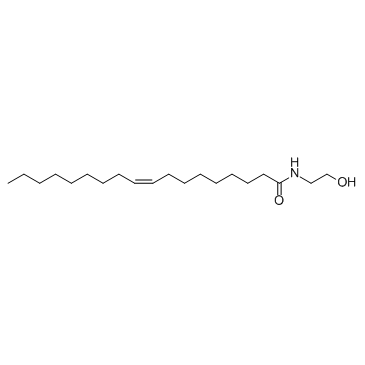
Oleoylethanolamide structure
|
Common Name | Oleoylethanolamide | ||
|---|---|---|---|---|
| CAS Number | 111-58-0 | Molecular Weight | 325.529 | |
| Density | 0.9±0.1 g/cm3 | Boiling Point | 496.4±38.0 °C at 760 mmHg | |
| Molecular Formula | C20H39NO2 | Melting Point | 50-60ºC | |
| MSDS | Chinese USA | Flash Point | 254.0±26.8 °C | |
| Symbol |

GHS07 |
Signal Word | Warning | |
Use of OleoylethanolamideOleoylethanolamide is a high affinity endogenous PPAR-α agonist, which plays an important role in the treatment of obesity and arteriosclerosis. |
| Name | oleoyl ethanolamide |
|---|---|
| Synonym | More Synonyms |
| Description | Oleoylethanolamide is a high affinity endogenous PPAR-α agonist, which plays an important role in the treatment of obesity and arteriosclerosis. |
|---|---|
| Related Catalog | |
| Target |
Human Endogenous Metabolite PPAR-α |
| In Vitro | Oleoylethanolamide (OEA), an endogenous PPAR-α ligand, attenuates liver fibrosis targeting hepatic stellate cells. Oleoylethanolamide suppresses TGF-β1 induced hepatic stellate cells (HSCs) activation in vitro via PPAR-α. To assess the impact of Oleoylethanolamide on HSCs activation, the expression levels of α-SMA and Col1a in TGF-β1-stimulated HSCs are examined by qPCR. The mRNA levels of α-SMA and Col1a are markedly induced in the group of CFSC cells with TGF-β1 (5 ng/mL) stimulation for 48h, while the mRNA levels are suppressed when treated with Oleoylethanolamide in a dose-dependent manner. Immunofluorescence and western blot results show that Oleoylethanolamide treatment dose-dependently inhibits the protein expression of α-SMA, the marker of HSC activation. The inhibitory effects of Oleoylethanolamide on HSCs activation are completely blocked by PPAR-α antagonist MK886 (10 μM). Moreover, the mRNA and protein expression levels of PPAR-α are down-regulated with TGF-β1 stimulation, while Oleoylethanolamide treatment restores these changes in dose-dependent manner. In addition, the phosphorylation of Smad 2/3 is upregulated in the presence of TGF-β1 stimulation, consistent with the observed effects on HSC activation, while Oleoylethanolamide (10 μM) reduces the phosphorylation of Smad2/3 in CFSC simulated with TGF-β1[1]. |
| In Vivo | Oleoylethanolamide (OEA) can significantly suppress the pro-fibrotic cytokine TGF-β1 negatively regulate genes in the TGF-β1 signaling pathway (α-SMA, collagen 1a, and collagen 3a) in mice models of hepatic fibrosis. Treatment with Oleoylethanolamide (5 mg/kg/day, intraperitoneal injection, i.p.) significantly attenuates the progress of liver fibrosis in both two experimental animal models by blocking the activation of hepatic stellate cells (HSCs)[1]. |
| Cell Assay | CFSC, HSC cell lines are first obtained from cirrhotic rat liver, and have a similar phenotype to that of early passage primary HSCs. CFSC cells are cultured in Dulbecco's modified Eagle's medium (DMEM) supplemented with 10% fetal bovine serum (FBS) and 1% penicillin/streptomycin. All cells are cultured in 6-well culture plates under 37°C and 5% CO2 in an incubator. The medium is replaced every two days, and the cells are harvested and diluted at a ratio of 1:3 twice a week. In experiments, HSCs are pretreated with the experimental concentration of Oleoylethanolamide (30 μM, 10 μM, 3 μM) before stimulation with 5 ng/mL TGF-β1. mRNA expression levels of α-SMA (A) and Col1a (B) are analyzed by real-time PCR[1]. |
| Animal Admin | Mice[1] The Sv/129 mice and PPAR-α knockout mice are maintained in a room with controlled temperature (21-23°C), humidity (55-60%) and lighting (12 h light/dark cycles) and given water ad libitum. Mice are randomly divided for methionine choline-deficient (MCD) and thioacetamide (TAA) experiments. In the MCD-diet feeding experiment, wild-type Sv/129 mice and PPAR-α knockout mice are each divided into three groups (n=8 /group): (i) control group receive normal diet; (ii) fed with MCD diet and injected with the vehicle (5% Tween-80+5% PEG400+90% saline, 5 mL/kg/day, 8 weeks, intraperitoneal injection, i.p.); (iii) fed with MCD diet along with Oleoylethanolamide administration (5 mg/kg/day; 8 weeks, i.p.). In another set of experiment, all the wild-type mice and PPAR-α knockout mice are given standard chow diet, and are randomly separated into three groups: the control group is not administrated TAA or Oleoylethanolamide but is injected with the saline; the TAA group is injected with TAA (160 mg/kg, three times per week, 6 weeks, dissolved in saline, i.p.) plus the corresponding vehicle; the Oleoylethanolamide group is both injected with TAA and Oleoylethanolamide (5 mg/kg/day; 6 weeks, i.p.)[1]. |
| References |
| Density | 0.9±0.1 g/cm3 |
|---|---|
| Boiling Point | 496.4±38.0 °C at 760 mmHg |
| Melting Point | 50-60ºC |
| Molecular Formula | C20H39NO2 |
| Molecular Weight | 325.529 |
| Flash Point | 254.0±26.8 °C |
| Exact Mass | 325.298065 |
| PSA | 49.33000 |
| LogP | 6.36 |
| Vapour Pressure | 0.0±2.9 mmHg at 25°C |
| Index of Refraction | 1.474 |
| InChIKey | BOWVQLFMWHZBEF-KTKRTIGZSA-N |
| SMILES | CCCCCCCC/C=CCCCCCCCC(=O)NCCO |
| Storage condition | −20°C |
| Symbol |
GHS07 |
|---|---|
| Signal Word | Warning |
| Hazard Statements | H315-H319-H335 |
| Precautionary Statements | P261-P305 + P351 + P338 |
| Personal Protective Equipment | dust mask type N95 (US);Eyeshields;Gloves |
| Hazard Codes | Xi:Irritant; |
| Risk Phrases | R36/37/38 |
| Safety Phrases | S26-S36 |
| RIDADR | NONH for all modes of transport |
| WGK Germany | 2 |
|
Activation of PPAR gamma receptors reduces levodopa-induced dyskinesias in 6-OHDA-lesioned rats.
Neurobiol. Dis. 74 , 295-304, (2015) Long-term administration of l-3,4-dihydroxyphenylalanine (levodopa), the mainstay treatment for Parkinson's disease (PD), is accompanied by fluctuations in its duration of action and motor complicatio... |
|
|
The human serum metabolome.
PLoS ONE 6(2) , e16957, (2011) Continuing improvements in analytical technology along with an increased interest in performing comprehensive, quantitative metabolic profiling, is leading to increased interest pressures within the m... |
|
|
A simple method for simultaneous determination of N-arachidonoylethanolamine, N-oleoylethanolamine, N-palmitoylethanolamine and 2-arachidonoylglycerol in human cells.
Anal. Bioanal. Chem 407(6) , 1781-7, (2015) The endocannabinoid system has been considered as a target for pharmacological intervention. Accordingly, inhibition of fatty acid amide hydrolase (FAAH), a degrading enzyme of the endocannabinoids N-... |
|
Name: Luminescence-based cell-based primary high throughput screening assay to identify ago...
Source: The Scripps Research Institute Molecular Screening Center
Target: mu-type opioid receptor isoform MOR-1 [Homo sapiens]
External Id: OPRM1-OPRD1_AG_LUMI_1536_1X%ACT PRUN
|
|
Name: Thermal Shift Assay. Domain: start/stop: M1-L298
Source: ChEMBL
Target: Cyclin-dependent kinase 2
External Id: CHEMBL5062802
|
|
Name: Inhibition of neurosphere proliferation of mouse neural precursor cells by MTT assay
Source: ChEMBL
Target: N/A
External Id: CHEMBL1266185
|
|
Name: Primary qHTS assay for inhibitors of alpha-synuclein gene (SNCA) expression
Source: NCGC
External Id: SNCA-p-activity-luciferase
|
|
Name: Fluorescence-based cell-based primary high throughput screening assay to identify ago...
Source: The Scripps Research Institute Molecular Screening Center
Target: muscarinic acetylcholine receptor M1 [Homo sapiens]
External Id: CHRM1_AG_FLUO8_1536_1X%ACT PRUN
|
|
Name: Agonist activity at human recombinant TRPV1 expressed in HEK293 cells assessed as inc...
Source: ChEMBL
Target: Transient receptor potential cation channel subfamily V member 1
External Id: CHEMBL994490
|
|
Name: Tested for binding affinity to Cannabinoid receptor 1
Source: ChEMBL
Target: Cannabinoid receptor 1
External Id: CHEMBL657061
|
|
Name: Tocris HTS for Inhibitors of Aerobactin Synthetase lucA
Source: 23265
External Id: IucA Pilot Assay Tocris Library
|
|
Name: Displacement of [3H]CP-55940 from human recombinant CB2 receptor expressed in HEK293 ...
Source: ChEMBL
Target: Cannabinoid receptor 2
External Id: CHEMBL994489
|
|
Name: Displacement of [3H]CP-55940 from human recombinant CB1 receptor expressed in HEK293 ...
Source: ChEMBL
Target: Cannabinoid receptor 1
External Id: CHEMBL994488
|
| Oleic acid ethanolamide |
| MFCD08059579 |
| N-(2-Hydroxyethyl)oleamide |
| N-(Hydroxyethyl)oleamide N-(cis-9-Octadecenoyl)ethanolamine OEA oleoylethanolamide |
| N-(9Z-octadecenoyl)-ethanolamine |
| Oleoyl monoethanolamide |
| (9Z)-N-(2-hydroxyethyl)octadec-9-enamide |
| N-oleoyl ethanolamide |
| Oleoylethanolamide |
| N-Oleoylethanolamine |
| N-Oleoyl-2-aminoethanol |
| (9Z)-N-(2-Hydroxyethyl)-9-octadecenamide |
| N-(cis-9-Octadecenoyl)ethanolamine |
| N-oleoyl ethanolamine |
| Oleic acid monoethanolamide |
| EINECS 203-884-8 |
| 9Z-octadecenoylethanolamide |
| Oleoyl Ethanolamide |
The content on this webpage is sourced from various professional data sources. If you have any questions or concerns regarding the content, please feel free to contact service1@chemsrc.com.
- Shanghai Nianxing Industrial Co., Ltd
- China
- Product Name: 9Z-octadecenoylethanolamide
- Price: Check
- Purity: 99.0%
- Delivery: 10 Day
- Contact: Yang
- Email: sales@echemcloud.com
- Dayang Chem (Hangzhou) Co., Ltd.
- China
- Product Name: N-Oleoylethanolamine
- Price: $Inquiry/100g $Inquiry/1kg $Inquiry/100kg $Inquiry/1000kg
- Purity: 98.0%
- Delivery: Inquiry
- Contact: Ms Wang
- Email: enquiry@dycnchem.com
- Henan Tianfu Chemical Co., Ltd.
- China
- Product Name: N-Oleoylethanolamine 111-58-0
- Price: $Inquiry/1kg $Inquiry/25kg $Inquiry/1000kg $Inquiry/10ton
- Purity: 99.0%
- Delivery: Inquiry
- Contact: Anson
- Email: info@tianfuchem.com
- Zhongshan Xingrui Chemical Co. , Ltd.
- China
- Product Name: Oleoylethanolamide
- Price: ¥Inquiry/25kg
- Purity: 85.0%
- Delivery: Inquiry
- Contact: Wang Jie

- Email: 3096638339@qq.com
Get all suppliers and price by the below link:
Reference only. check more Oleoylethanolamide price