U 92016A
Modify Date: 2026-07-24 18:59:34
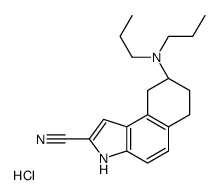
U 92016A structure
|
Common Name | U 92016A | ||
|---|---|---|---|---|
| CAS Number | 149654-41-1 | Molecular Weight | 331.88300 | |
| Density | N/A | Boiling Point | N/A | |
| Molecular Formula | C19H26ClN3 | Melting Point | N/A | |
| MSDS | N/A | Flash Point | N/A | |
Use of U 92016AU92016A hydrochloride is a potent, metabolically stable, orally acitive 5-HT1A receptor agonist with an exceptionally high degree of intrinsic activity[1][2]. U92016A hydrochloride binds with high affinity to human 5-HT1A receptors expressed in Chinese hamster ovary cells (Ki=0.2 nM)[2]. |
| Name | (8R)-8-(dipropylamino)-6,7,8,9-tetrahydro-3H-benzo[e]indole-2-carbonitrile |
|---|---|
| Synonym | More Synonyms |
| Description | U92016A hydrochloride is a potent, metabolically stable, orally acitive 5-HT1A receptor agonist with an exceptionally high degree of intrinsic activity[1][2]. U92016A hydrochloride binds with high affinity to human 5-HT1A receptors expressed in Chinese hamster ovary cells (Ki=0.2 nM)[2]. |
|---|---|
| Related Catalog | |
| Target |
5-HT1A Receptor:0.2 nM (Ki) |
| In Vitro | U92016A (U-92016A) is selective for the 5-HT1A receptor over other biogenic amine receptors. U92016A decreases the Forskolin-induced increase in cyclic AMP synthesis and has an intrinsic activity of 0.82 relative to 5-HT in Chinese hamster ovary cells expressing the human 5HT1A receptor[2]. |
| In Vivo | U92016A (U-92016A) potently decreases rectal temperature in mice. U92016A also elicits the 5-HT-mediated syndrome in rats and results in a dose-related decrease in 5-hydroxytryptophan accumulation. U92016A also decreases arterial blood pressure in spontaneously hypertensive rats and inhibits sympathetic nerve activity in cats. U92016A displays excellent potency and a long duration of action. U92016A also inhibits the firing of dorsal raphe 5-HT neurons and is active in two social interaction assays. The p.o. bioavailability of U92016A is 45%[2]. |
| References |
| Molecular Formula | C19H26ClN3 |
|---|---|
| Molecular Weight | 331.88300 |
| Exact Mass | 331.18200 |
| PSA | 42.82000 |
| LogP | 4.82088 |
| InChIKey | XHLKAMFNZKKRFJ-PKLMIRHRSA-N |
| SMILES | CCCN(CCC)C1CCc2ccc3[nH]c(C#N)cc3c2C1.Cl |
|
Name: Thermal Shift Assay. Domain: start/stop: N44-E168
Source: ChEMBL
Target: Bromodomain-containing protein 4
External Id: CHEMBL5060944
|
|
Name: Thermal Shift Assay. Domain start/stop: M626-G740
Source: ChEMBL
Target: Peregrin
External Id: CHEMBL4650107
|
|
Name: Thermal Shift Assay. Domain: start/stop: M1-L298
Source: ChEMBL
Target: Cyclin-dependent kinase 2
External Id: CHEMBL5062802
|
|
Name: Thermal Shift Assay. Domain: start/stop: M1-S360
Source: ChEMBL
Target: Mitogen-activated protein kinase 1
External Id: CHEMBL5067335
|
|
Name: Thermal Shift Assay. Domain: start/stop: M1-L298
Source: ChEMBL
Target: Cyclin-dependent kinase 2
External Id: CHEMBL5063619
|
|
Name: Thermal Shift Assay. Domain: start/stop: P449-E759
Source: ChEMBL
Target: Fibroblast growth factor receptor 3
External Id: CHEMBL5065477
|
|
Name: Thermal Shift Assay. Domain: start/stop: N44-E168
Source: ChEMBL
Target: Bromodomain-containing protein 4
External Id: CHEMBL5061761
|
|
Name: Thermal Shift Assay. Domain: start/stop: E122-S403
Source: ChEMBL
Target: Aurora kinase A
External Id: CHEMBL5067447
|
|
Name: GPCR beta-arrestin recruitment assay with target: GPR35 Assay Type: PRESTO-Tango Conc...
Source: ChEMBL
Target: G-protein coupled receptor 35
External Id: CHEMBL5209835
|
|
Name: GPCR beta-arrestin recruitment assay with target: S1PR1 Assay Type: PRESTO-Tango Conc...
Source: ChEMBL
Target: Sphingosine 1-phosphate receptor 1
External Id: CHEMBL5209836
|
Total 45, Current Page 1 of 5
1
2
3
4
5
| U-92,016-A |
| (+)-R)-2-cyano-N,N-dipropyl-8-amino-6,7,8,9-tetrahydro-3H-benz[e]indole |