quinine hydrobromide
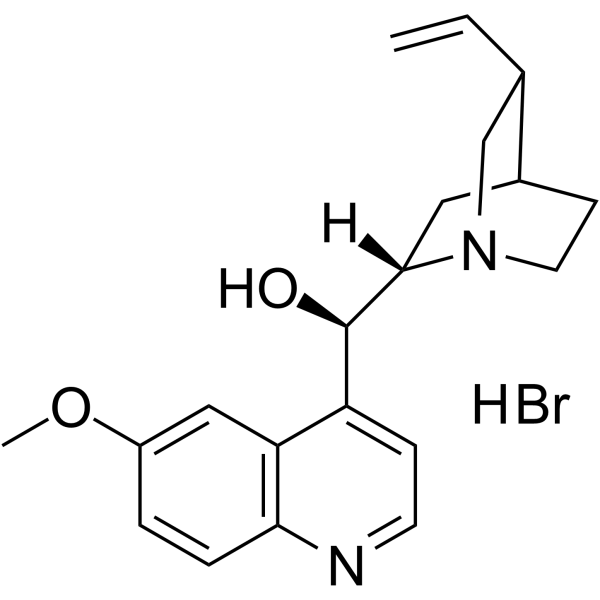
quinine hydrobromide structure
|
Common Name | quinine hydrobromide | ||
|---|---|---|---|---|
| CAS Number | 549-49-5 | Molecular Weight | 405.32900 | |
| Density | 1.21g/cm3 | Boiling Point | 495.9ºC at 760mmHg | |
| Molecular Formula | C20H25BrN2O2 | Melting Point | 81-82ºC | |
| MSDS | N/A | Flash Point | 253.7ºC | |
Use of quinine hydrobromideQuinidine hydrobromide is an antiarrhythmic agent. Quinidine is a potent, orally active, selective cytochrome P450db inhibitor. Quinidine hydrobromide is also a K+ channel blocker with an IC50 of 19.9 μM. Quinidine hydrobromide can be used for malaria research[1][2][3]. |
Summary: Quinine hydrobromide, with the chemical name (R)-[(2S,4S,5R)-5-ethenyl-1-azabicyclo[2.2.2]octan-2-yl]-(6-methoxyquinolin-4-yl)methanol, CAS number 549-49-5, has a molecular formula of C20H25BrN2O2 and a molecular weight of 405.32900. For research-use only, not for medical or clinical usage.
This table lists Chinese names, IUPAC names and various aliases of this chemical substance.
| Name | (R)-[(2S,4S,5R)-5-ethenyl-1-azabicyclo[2.2.2]octan-2-yl]-(6-methoxyquinolin-4-yl)methanol,hydrobromide |
|---|---|
| Synonym | More Synonyms |
This table contains bioactivity, target information and biological‑assay experimental data of this compound.
| Description | Quinidine hydrobromide is an antiarrhythmic agent. Quinidine is a potent, orally active, selective cytochrome P450db inhibitor. Quinidine hydrobromide is also a K+ channel blocker with an IC50 of 19.9 μM. Quinidine hydrobromide can be used for malaria research[1][2][3]. |
|---|---|
| Related Catalog | |
| In Vitro | Quinidine hydrobromide is an anti-arrythmic drug which affects ionic currents in heart muscle and which has also been shown to be a potent blocker of several classes of K+ channel in a variety of cell types[1]. Bath application of quinidine hydrobromide causes a dose-dependent reduction of the peak amplitude of Ik. The Kd for blockade of Ik at 0 mV is estimated to be 41 μM[1]. Quinidine hydrobromide elicits a dose-dependent increase of the rate of the decay of Ik and this effect is enhanced by membrane depolarization. Quinidine also causes a 5 mV hyperpolarizing shift of the steady-state inactivation curve and increases the half-time for recovery from inactivation. Quinidine hydrobromide does not affect the onset of inactivation measured at -30 mV[1]. |
| In Vivo | Quinidine hydrobromide is rapidly absorbed, with peak plasma concentrations 60-90 min after an oral dose. Other salts (gluconate, polygalacturonate) are more slowly absorbed, with lower peak concentrations[2]. Quinidine hydrobromide is approximately 70-90 % bound to plasma proteins. It undergoes hepatic oxidative metabolism to form an N-oxide, a 3-hydroxy form, an O-demethyl form and 2'-quinidinone[2]. Quinidine hydrobromide inhibits metabolism of amphetamine in rats. Quinidine hydrobromide pretreatment results in a significant decrease in the excretion of p-hydroxyamphetamine at 24 and 48 h to 7.2 and 24.1% of the vehicle-control levels, respectively, accompanied by a significant increase in amphetamine excretion between 24 and 48 h to 542% of the control[3]. |
| References |
This table shows physicochemical parameters including melting point, boiling point, density, solubility and optical rotation. Missing data is marked as N/A.
| Density | 1.21g/cm3 |
|---|---|
| Boiling Point | 495.9ºC at 760mmHg |
| Melting Point | 81-82ºC |
| Molecular Formula | C20H25BrN2O2 |
| Molecular Weight | 405.32900 |
| Flash Point | 253.7ºC |
| Exact Mass | 404.11000 |
| PSA | 45.59000 |
| LogP | 4.06920 |
| InChIKey | HDZGBIRSORQVNB-DSXUQNDKSA-N |
| SMILES | Br.C=CC1CN2CCC1CC2C(O)c1ccnc2ccc(OC)cc12 |
This table summarizes toxicological test data, acute & chronic toxicity and ecological hazard parameters for this chemical.
CHEMICAL IDENTIFICATION
HEALTH HAZARD DATAACUTE TOXICITY DATA
|
This table covers safety warnings, protective measures, incompatible substances and disposal guidelines for this compound.
| Hazard Codes | Xn,Xi |
|---|---|
| Risk Phrases | 20/21/22-36/37/38-42/43 |
| RIDADR | UN 1544 |
| Packaging Group | III |
| Hazard Class | 6.1(b) |
| HS Code | 29392000 |
This table shows customs‑related data including HS‑code, tariff and regulatory conditions for import and export.
| HS Code | 29392000 |
|---|
This table collects all English aliases, systematic names and CAS‑related synonyms of the compound.
| Chinin hydrobromid |
| QUININE HYDROBROMIDE |
| Quinine,monohydrobromide |
| UNII-VWF36Q4G6V |
| Chinin hydrobromid [German] |
| Quinine hydrobromide [NF] |
| EINECS 208-967-2 |
| Bromoquinine |
This section contains frequently‑asked‑questions about this compound, including basic parameters, properties, storage conditions and corresponding answers.
| Q: What is the SMILES notation of (R)-[(2S,4S,5R)-5-ethenyl-1-azabicyclo[2.2.2]octan-2-yl]-(6-methoxyquinolin-4-yl)methanol,hydrobromide? |
| A: SMILES notation of (R)-[(2S,4S,5R)-5-ethenyl-1-azabicyclo[2.2.2]octan-2-yl]-(6-methoxyquinolin-4-yl)methanol,hydrobromide is Br.C=CC1CN2CCC1CC2C(O)c1ccnc2ccc(OC)cc12. |
| Q: What are the uses of (R)-[(2S,4S,5R)-5-ethenyl-1-azabicyclo[2.2.2]octan-2-yl]-(6-methoxyquinolin-4-yl)methanol,hydrobromide? |
| A: Main uses of (R)-[(2S,4S,5R)-5-ethenyl-1-azabicyclo[2.2.2]octan-2-yl]-(6-methoxyquinolin-4-yl)methanol,hydrobromide: Quinidine hydrobromide is an antiarrhythmic agent. Quinidine is a potent, orally active, selective cytochrome P450db inhibitor. Quinidine hydrobromide is also a K+ channel blocker with an IC50 of 19.9 μM. Quinidine hydrobromide can be used for malaria research[1][2][3]. |
| Q: What is the LogP of (R)-[(2S,4S,5R)-5-ethenyl-1-azabicyclo[2.2.2]octan-2-yl]-(6-methoxyquinolin-4-yl)methanol,hydrobromide? |
| A: LogP of (R)-[(2S,4S,5R)-5-ethenyl-1-azabicyclo[2.2.2]octan-2-yl]-(6-methoxyquinolin-4-yl)methanol,hydrobromide is 4.06920. |
| Q: What is the English name of (R)-[(2S,4S,5R)-5-ethenyl-1-azabicyclo[2.2.2]octan-2-yl]-(6-methoxyquinolin-4-yl)methanol,hydrobromide? |
| A: The English name of (R)-[(2S,4S,5R)-5-ethenyl-1-azabicyclo[2.2.2]octan-2-yl]-(6-methoxyquinolin-4-yl)methanol,hydrobromide is (R)-[(2S,4S,5R)-5-ethenyl-1-azabicyclo[2.2.2]octan-2-yl]-(6-methoxyquinolin-4-yl)methanol,hydrobromide. |
| Q: What is the molecular weight of (R)-[(2S,4S,5R)-5-ethenyl-1-azabicyclo[2.2.2]octan-2-yl]-(6-methoxyquinolin-4-yl)methanol,hydrobromide? |
| A: Molecular weight of (R)-[(2S,4S,5R)-5-ethenyl-1-azabicyclo[2.2.2]octan-2-yl]-(6-methoxyquinolin-4-yl)methanol,hydrobromide is 405.32900. |
| Q: What is the boiling point of (R)-[(2S,4S,5R)-5-ethenyl-1-azabicyclo[2.2.2]octan-2-yl]-(6-methoxyquinolin-4-yl)methanol,hydrobromide? |
| A: Boiling point of (R)-[(2S,4S,5R)-5-ethenyl-1-azabicyclo[2.2.2]octan-2-yl]-(6-methoxyquinolin-4-yl)methanol,hydrobromide is 495.9ºC at 760mmHg. |
| Q: What is the InChIKey of (R)-[(2S,4S,5R)-5-ethenyl-1-azabicyclo[2.2.2]octan-2-yl]-(6-methoxyquinolin-4-yl)methanol,hydrobromide? |
| A: InChIKey of (R)-[(2S,4S,5R)-5-ethenyl-1-azabicyclo[2.2.2]octan-2-yl]-(6-methoxyquinolin-4-yl)methanol,hydrobromide is HDZGBIRSORQVNB-DSXUQNDKSA-N. |
| Q: What English synonyms does (R)-[(2S,4S,5R)-5-ethenyl-1-azabicyclo[2.2.2]octan-2-yl]-(6-methoxyquinolin-4-yl)methanol,hydrobromide have? |
| A: English synonyms of (R)-[(2S,4S,5R)-5-ethenyl-1-azabicyclo[2.2.2]octan-2-yl]-(6-methoxyquinolin-4-yl)methanol,hydrobromide: Chinin hydrobromid, QUININE HYDROBROMIDE, Quinine,monohydrobromide, UNII-VWF36Q4G6V, Chinin hydrobromid [German], Quinine hydrobromide [NF], EINECS 208-967-2, Bromoquinine. |
| Q: What is the melting point of (R)-[(2S,4S,5R)-5-ethenyl-1-azabicyclo[2.2.2]octan-2-yl]-(6-methoxyquinolin-4-yl)methanol,hydrobromide? |
| A: Melting point of (R)-[(2S,4S,5R)-5-ethenyl-1-azabicyclo[2.2.2]octan-2-yl]-(6-methoxyquinolin-4-yl)methanol,hydrobromide is 81-82ºC. |
| Q: What is the molecular formula of (R)-[(2S,4S,5R)-5-ethenyl-1-azabicyclo[2.2.2]octan-2-yl]-(6-methoxyquinolin-4-yl)methanol,hydrobromide? |
| A: Molecular formula of (R)-[(2S,4S,5R)-5-ethenyl-1-azabicyclo[2.2.2]octan-2-yl]-(6-methoxyquinolin-4-yl)methanol,hydrobromide is C20H25BrN2O2. |
This table lists manufacturers and suppliers of this compound, including vendor names and product supply reference information.
| Dayang Chem (Hangzhou) Co., Ltd. |