N4-氨基胞苷
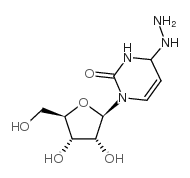
N4-氨基胞苷结构式

|
常用名 | N4-氨基胞苷 | 英文名 | n4-aminocytidine |
|---|---|---|---|---|
| CAS号 | 57294-74-3 | 分子量 | 258.23 | |
| 密度 | 1.93g/cm3 | 沸点 | 555.5ºC at 760mmHg | |
| 分子式 | C9H14N4O5 | 熔点 | >160 °C(sublime) | |
| MSDS | 中文版 美版 | 闪点 | 289.8ºC | |
| 符号 |

GHS07 |
信号词 | Warning |
|
Genotoxic properties of representatives of alkylindazoles and aminoalkyl-indoles which are consumed as synthetic cannabinoids.
Food Chem. Toxicol. 80 , 130-6, (2015) Synthetic cannabinoids (SCs) cause similar effects as cannabis and are sold in herbal mixtures. Recent investigations indicate that some of these drugs possess genotoxic properties. Therefore, we tested representatives of two groups, namely, aminoalkylindoles... |
|
|
Mutagenic nucleoside analog N4-aminocytidine: metabolism, incorporation into DNA, and mutagenesis in Escherichia coli.
J. Bacteriol. 170(11) , 5257-62, (1988) N4-Aminocytidine, a nucleoside analog, is strongly mutagenic to various organisms including Escherichia coli. Using E. coli WP2 (trp), we measured the incorporation of [5-3H]N4-aminocytidine into DNA and at the same time measured the frequency of reversion of... |
|
|
An improved synthesis of N4-aminocytidine.
Chem. Pharm. Bull. 35(9) , 3884-7, (1987)
|
|
|
[Molecular mechanism of N4-aminocytidine mutagenesis].
Yakugaku Zasshi 110(5) , 293-303, (1990) N4-Aminocytidine is strongly mutagenic towards E. coli, S. typhimurium, B. subtilis and coliphages phi X174 and M13mp2. It also causes mutations in mammalian cell lines and somatic cell mutations in D. melanogaster. The sequence analysis of deoxyribonucleic a... |
|
|
Mutagenesis by N4-aminocytidine: induction of AT to GC transition and its molecular mechanism.
Biochemistry 24 , 7273, (1985) N4-Aminocytidine is a potent mutagen toward Escherichia coli and Salmonella typhimurium. It induced reversion of an amber mutant of phi X174 phage (am3) to the wild type. This reversion was shown to be exclusively due to the AT to GC transition. It is likely ... |
|
|
Induction of mutation in mouse FM3A cells by N4-aminocytidine-mediated replicational errors.
Mol. Cell. Biol. 8(1) , 347-52, (1988) To explore the potential use of a nucleoside analog, N4-aminocytidine, in studies of cellular biology, the mechanism of mutation induced by this compound in mouse FM3A cells in culture was studied. On treatment of cells in suspension with N4-aminocytidine, th... |
|
|
N4-aminocytidine: formation, reactivity, and mutagenicity.
Nucleic Acids Symp. Ser. (12) , 29-30, (1983) N4-Aminocytidine was readily formed on treatment of cytidine with hydrazine-bisulfite under mild conditions. This reaction can be carried out for cytosines in polynucleotids as well. The nucleoside N4-aminocytidine was strongly mutagenic to bacteria and phage... |
|
|
Binding specificities of the mismatch binding protein, MutS, to oligonucleotides containing modified bases.
Nucleic Acids Res. Suppl. (1) , 221-2, (2001) We have studied the effects of DNA mismatch repair on mutagenesis induced by nucleoside analogs. Among them, the mutagenic action of 3,4-dihydro-6H,8H-pyrimido[4,5-c][1,2]oxazin-7-one 2'-deoxyriboside (dP) showed high susceptibility to the mismatch repair sys... |
|
|
The genotoxicity of N4-aminocytidine in the Drosophila wing spot test.
Mutagenesis 3(1) , 11-3, (1988) The nucleoside analogue N4-aminocytidine is known to induce mutations in bacteria, and was shown to induce somatic mutations in Drosophila melanogaster after larval administration. The assay system employed was a wing-hair mutation spot test developed by Würg... |
|
|
Effects of the umuDC, mucAB, and samAB operons on the mutational specificity of chemical mutagenesis in Escherichia coli: II. Base substitution mutagenesis.
Mutat. Res. 314(1) , 39-49, (1994) Mutational spectra induced by different classes of chemical mutagens including two ultraviolet-mimetic mutagens, an alkylating agent, intercalators, a crosslinking agent, and base analogs were characterized by means of a set of mutant lacZ genes in E. coli. T... |