对羟基苯丙酸
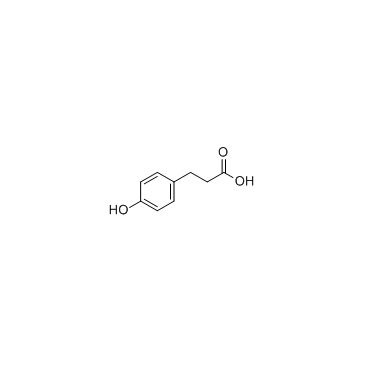
对羟基苯丙酸结构式

|
常用名 | 对羟基苯丙酸 | 英文名 | Desaminotyrosine |
|---|---|---|---|---|
| CAS号 | 501-97-3 | 分子量 | 166.174 | |
| 密度 | 1.3±0.1 g/cm3 | 沸点 | 352.4±17.0 °C at 760 mmHg | |
| 分子式 | C9H10O3 | 熔点 | 129-131 °C(lit.) | |
| MSDS | 中文版 美版 | 闪点 | 181.1±17.4 °C | |
| 符号 |

GHS07 |
信号词 | Warning |
|
Hydroxycinnamic acids used as external acceptors of electrons: an energetic advantage for strictly heterofermentative lactic acid bacteria.
Appl. Environ. Microbiol. 80(24) , 7574-82, (2014) The metabolism of hydroxycinnamic acids by strictly heterofermentative lactic acid bacteria (19 strains) was investigated as a potential alternative energy route. Lactobacillus curvatus PE5 was the most tolerant to hydroxycinnamic acids, followed by strains o... |
|
|
A metabolite profiling approach to identify biomarkers of flavonoid intake in humans.
J. Nucl. Med. 139 , 2309-14, (2009) Flavonoids are phytochemicals that are widespread in the human diet. Despite limitations in their bioavailability, experimental and epidemiological data suggest health benefits of flavonoid consumption. Valid biomarkers of flavonoid intake may be useful for e... |
|
|
Development of a targeted method for twenty-three metabolites related to polyphenol gut microbial metabolism in biological samples, using SPE and UHPLC-ESI-MS/MS.
Talanta 128 , 221-30, (2014) An increasing number of studies have concerned the profiling of polyphenol microbial metabolites, especially in urine or plasma, but only a few have regarded their accurate quantification. This study reports on a new ultra-performance liquid chromatography ta... |
|
|
Production of an anthocyanin-rich food colourant from Thymus moroderi and its application in foods.
J. Sci. Food Agric. 95(6) , 1283-93, (2015) Anthocyanins and other polyphenols from flowers and bracts of Thymus sp. are studied. An anthocyanin-rich food colourant with interesting high antioxidant activity from Thymus moroderi has been obtained, and applied to colour foods.Anthocyanins and other poly... |
|
|
Ion-pairing reversed-phase liquid chromatography fractionation in combination with isotope labeling reversed-phase liquid chromatography–mass spectrometry for comprehensive metabolome profiling
J. Chromatogr. A. 1218(23) , 3689-94, (2011) We report a novel two-dimensional (2D) separation strategy aimed at improving the detectability of liquid chromatography mass spectrometry (LC–MS) for metabolome analysis. It is based on the use of ion-pairing (IP) reversed-phase (RP) LC as the first dimensio... |
|
|
An efficient and economical MTT assay for determining the antioxidant activity of plant natural product extracts and pure compounds.
J. Nat. Prod. 73 , 1193-5, (2010) Antioxidants scavenge free radicals, singlet oxygen, and electrons in cellular redox reactions. The yellow MTT [3-(4,5-dimethylthiazole-2-yl)-2,5-diphenyltetrazolium bromide] is reduced to a purple formazan by mitochondrial enzymes. NADPH is the basis of esta... |
|
|
Growth-rate dependency of de novo resveratrol production in chemostat cultures of an engineered Saccharomyces cerevisiae strain.
Microb. Cell Fact. 14 , 133, (2015) Saccharomyces cerevisiae has become a popular host for production of non-native compounds. The metabolic pathways involved generally require a net input of energy. To maximize the ATP yield on sugar in S. cerevisiae, industrial cultivation is typically perfor... |
|
|
Fate of microbial metabolites of dietary polyphenols in rats: is the brain their target destination?
ACS Chem. Neurosci. 6 , 1341-52, (2015) Different polyphenol compounds are ingested when consuming a serving of fruits rich in polyphenols, spanning from one-phenol hydroxybenzoic acid to more complex polymeric compounds. Only a minor quantity of the polyphenols (5-10%) is absorbed. The remainder r... |
|
|
Carbon nanotubes supported tyrosinase in the synthesis of lipophilic hydroxytyrosol and dihydrocaffeoyl catechols with antiviral activity against DNA and RNA viruses.
Bioorg. Med. Chem. 23 , 5345-51, (2015) Hydroxytyrosol and dihydrocaffeoyl catechols with lipophilic properties have been synthesized in high yield using tyrosinase immobilized on multi-walled carbon nanotubes by the Layer-by-Layer technique. All synthesized catechols were evaluated against a large... |
|
|
Supplementation with grape seed polyphenols results in increased urinary excretion of 3-hydroxyphenylpropionic Acid, an important metabolite of proanthocyanidins in humans.
J. Agric. Food Chem. 52(17) , 5545-9, (2004) Grape seed extract provides a concentrated source of polyphenols, most of which are proanthocyanidins. Polymeric proanthocyanidins are poorly absorbed in the small intestine of humans, and exposure may result from metabolism to phenolic acids by colonic bacte... |