衣霉素
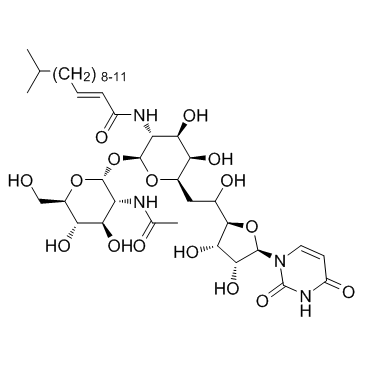
衣霉素结构式

|
常用名 | 衣霉素 | 英文名 | Tunicamycin |
|---|---|---|---|---|
| CAS号 | 11089-65-9 | 分子量 | 844.94 (n=10) | |
| 密度 | 1.4±0.1 g/cm3 | 沸点 | N/A | |
| 分子式 | C39H64N4O16(n=10) | 熔点 | 234 - 235ºC | |
| MSDS | 中文版 美版 | 闪点 | N/A | |
| 符号 |

GHS06 |
信号词 | Danger |
衣霉素用途Tunicamycin是来自Streptomyces lysosuperijkus的含有N-乙酰氨基葡糖的抗生素,抑制蛋白质糖基化。 |

摘要:衣霉素(Tunicamycin)是一种白色结晶固体,CAS号为11089-65-9,分子式为C39H64N4O16(n=10),分子量为844.94(n=10)。它是一种抗生素,也是糖基化的抑制剂。仅供科研实验参考,不作为医疗诊断与用药依据。
本表展示该化学物质的中文名称、英文系统名、各类中文与英文别名信息。
| 中文名 | 衣霉素 |
|---|---|
| 英文名 | tunicamycin |
| 中文别名 | 链病毒菌素 | 源于STREPTOMYCESLYSOSUPERFIUSNOV.SP.的链病毒菌素 |
| 英文别名 | 更多 |
本表记录该化合物相关生物活性、作用靶点、活性说明与生物实验相关数据。
| 描述 | Tunicamycin是来自Streptomyces lysosuperijkus的含有N-乙酰氨基葡糖的抗生素,抑制蛋白质糖基化。 |
|---|---|
| 相关类别 | |
| 参考文献 |
本表包含该物质理化参数,如熔点、沸点、密度、溶解度、旋光性等理化指标,无数据项标记为N/A。
| 密度 | 1.4±0.1 g/cm3 |
|---|---|
| 熔点 | 234 - 235ºC |
| 分子式 | C39H64N4O16(n=10) |
| 分子量 | 844.94 (n=10) |
| PSA | 311.82000 |
| LogP | 2.58 |
| 外观性状 | 白色结晶固体 |
| 折射率 | 1.617 |
| 储存条件 | 贮存温度2−8°C干燥处。 |
| 稳定性 | 遵照规格使用和储存则不会分解。 |
| 分子结构 | 1、摩尔折射率:无可用 2、 摩尔体积(cm3/mol): 无可用 3、 等张比容(90.2K):无可用 4、 表面张力(dyne/cm):无可用 |
| 计算化学 | 1、 疏水参数计算参考值(XlogP):-0.3 2、 氢键供体数量:11 3、 氢键受体数量:16 4、 可旋转化学键数量:19 5、 拓扑分子极性表面积(TPSA):306 6、 重原子数量:57 7、 表面电荷:0 8、 复杂度:1400 9、 同位素原子数量:0 10、 确定原子立构中心数量:13 11、 不确定原子立构中心数量:2 12、 确定化学键立构中心数量:1 13、 不确定化学键立构中心数量:0 14、 共价键单元数量:1 |
| 更多 | 1. 性状:白色或浅黄褐色粉末 2. 密度(g/mL,25/4℃): 无可用 3. 相对蒸汽密度(g/mL,空气=1):无可用 4. 熔点(ºC):无可用 5. 沸点(ºC,常压):无可用 6. 沸点(ºC,5.2kPa): 无可用 7. 折射率: 无可用 8. 闪点(ºC): 无可用 9. 比旋光度(º):无可用 10. 自燃点或引燃温度(ºC):无可用 11. 蒸气压(kPa,25ºC):无可用 12. 饱和蒸气压(kPa,60ºC):无可用 13. 燃烧热(KJ/mol):无可用 14. 临界温度(ºC):无可用 15. 临界压力(KPa):无可用 16. 油水(辛醇/水)分配系数的对数值:无可用 17. 爆炸上限(%,V/V):无可用 18. 爆炸下限(%,V/V): 无可用 19. 溶解性:溶于甲醇,参考浓度5mg/ml。 |
本表汇总该化学品毒理试验数据、急性慢性毒性以及环境生态危害相关参数。
|
衣霉素毒理学数据: 1 。 衣霉素生态学数据: 该物质对环境可能有危害,对水体应给予特别注意。 |
本表记录该化合物安全警示、防护措施、禁配物、处置方式等安全相关参考信息。
| 符号 |
GHS06 |
|---|---|
| 信号词 | Danger |
| 危害声明 | H300 |
| 警示性声明 | P264-P301 + P310 |
| 个人防护装备 | Eyeshields;Faceshields;full-face particle respirator type N100 (US);Gloves;respirator cartridge type N100 (US);type P1 (EN143) respirator filter;type P3 (EN 143) respirator cartridges |
| 危害码 (欧洲) | T+: Very toxic; |
| 风险声明 (欧洲) | 28 |
| 安全声明 (欧洲) | 28-37/39-45 |
| 危险品运输编码 | UN 3462 6 |
| WGK德国 | 3 |
| RTECS号 | YO7980200 |
| 包装等级 | II |
| 危险类别 | 6.1(a) |
| 海关编码 | 29419090 |
本表为该化合物相关公开文献,包含文献标题、期刊、发表信息等参考资料。
|
Unbiased Cell-based Screening in a Neuronal Cell Model of Batten Disease Highlights an Interaction between Ca2+ Homeostasis, Autophagy, and CLN3 Protein Function.
J. Biol. Chem. 290 , 14361-80, (2015) Abnormal accumulation of undigested macromolecules, often disease-specific, is a major feature of lysosomal and neurodegenerative disease and is frequently attributed to defective autophagy. The mecha... |
|
|
RIPK1 regulates survival of human melanoma cells upon endoplasmic reticulum stress through autophagy.
Autophagy 11 , 975-94, (2015) Although RIPK1 (receptor [TNFRSF]-interacting protein kinase 1) is emerging as a critical determinant of cell fate in response to cellular stress resulting from activation of death receptors and DNA d... |
|
|
Identification of Cell Surface Straight Chain Poly-N-Acetyl-Lactosamine Bearing Protein Ligands for VH4-34-Encoded Natural IgM Antibodies.
J. Immunol. 195 , 5178-88, (2015) B cell binding and cytotoxicity by human VH4-34-encoded Abs of the IgM isotype has been well documented. A VH4-34-IgM has recently shown a favorable early response in a phase 1 trial for treatment of ... |
本表罗列该化合物全部英文别名、系统命名、CAS别名等英文名称集合。
| TUNICAMYCIN,STREPTOMYCES LYSOSUPERFICUS |
| MFCD00065709 |
| Tunicamycin Streptomyces sp. |
| (2E)-N-[(2S,3R,4R,5R,6R)-2-{[(2S,3S,4S,5R,6S)-3-Acetamido-4,5-dihydroxy-6-(hydroxymethyl)tetrahydro-2H-pyran-2-yl]oxy}-6-{(2R)-2-[(2R,3S,4R,5R)-5-(2,4-dioxo-3,4-dihydro-1(2H)-pyrimidinyl)-3,4-dihydroxytetrahydro-2-furanyl]-2-hydroxyethyl}-4,5-dihydroxytetrahydro-2H-pyran-3-yl]-12-methyl-2-tridecenamide |
| (2E)-N-[(2S,3R,4R,5R,6R)-2-{[(2S,3S,4S,5R,6S)-3-Acetamido-4,5-dihydroxy-6-(hydroxymethyl)tetrahydro-2H-pyran-2-yl]oxy}-6-{(2R)-2-[(2R,3S,4R,5R)-5-(2,4-dioxo-3,4-dihydropyrimidin-1(2H)-yl)-3,4-dihydroxytetrahydrofuran-2-yl]-2-hydroxyethyl}-4,5-dihydroxytetrahydro-2H-pyran-3-yl]-12-methyltridec-2-enamide (non-preferred name) |
| TUNICAMYCIN |
本部分为该化合物相关常见问答,包含基础参数、性状、储存条件等高频咨询问题与对应答案。
| Q: 衣霉素有什么用途? |
| A: 衣霉素主要用途:Tunicamycin是来自Streptomyces lysosuperijkus的含有N-乙酰氨基葡糖的抗生素,抑制蛋白质糖基化。 |
| Q: 衣霉素的极性表面积PSA是多少? |
| A: 衣霉素极性表面积PSA为311.82000。 |
| Q: 衣霉素有哪些中文别名? |
| A: 衣霉素中文别名有:链病毒菌素、 源于STREPTOMYCESLYSOSUPERFIUSNOV.SP.的链病毒菌素。 |
| Q: 衣霉素的英文名称是什么? |
| A: 衣霉素英文名称为tunicamycin。 |
| Q: 衣霉素的熔点是多少? |
| A: 衣霉素熔点为234 - 235ºC。 |
| Q: 衣霉素的外观是什么? |
| A: 衣霉素外观为白色结晶固体。 |
| Q: 衣霉素的分子量是多少? |
| A: 衣霉素分子量为844.94 (n=10)。 |
| Q: 衣霉素的分子式是什么? |
| A: 衣霉素分子式为C39H64N4O16(n=10)。 |
| Q: 衣霉素的安全信息是什么? |
| A: 衣霉素安全信息:28-37/39-45。 |
| Q: 11089-65-9的中文名称是什么? |
| A: 11089-65-9的中文名称为衣霉素。 |
本表列出该化合物相关生产厂商、供应商信息,包含厂家名称、产品供应相关参考信息。
| 上海阿拉丁生化科技股份有限公司 |
| 苏州市森菲达化工有限公司 |
| 上海化源世纪贸易有限公司 |
本网页内容来自不同专业数据源,如对内容有疑义,欢迎联系service1@chemsrc.com。

 351666998
复制
351666998
复制

 133 1186 9306
复制
133 1186 9306
复制

- 上海阿拉丁生化科技股份有限公司
- 上海市 上海市 浦东新区
- 产品名:衣霉素
- 纯度:98.0%
- 价格: ¥2059.9/10mg ¥411.9/1mg ¥1539.9/5mg ¥8999.9/50mg
- 联系人:阿拉丁
 2881459338
复制
2881459338
复制
- 联系电话:400-620-6333
- 苏州市森菲达化工有限公司
- 江苏省 苏州市 相城区
- 产品名:衣霉素
- 纯度:98.0%
- 价格: ¥需询单/200kg
- 联系人:程经理
3912721726
复制

 18796480002
复制
18796480002
复制

- 联系电话:18796480002
- 上海化源世纪贸易有限公司
- 上海市 上海市 普陀区
- 产品名:衣霉素
- 纯度:98.0%
- 价格:
- 联系人:徐经理
351666998
复制
133 1186 9306
复制
- 联系电话:133 1186 9306
查看所有供应商和价格请点击: