Diiodohydroxyquinoline
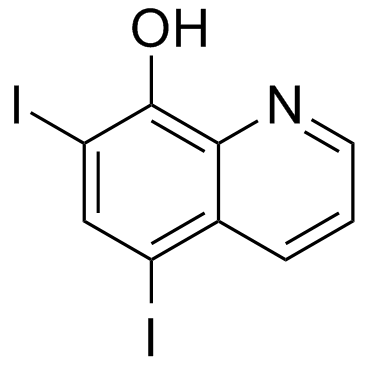
Diiodohydroxyquinoline structure
|
Common Name | Diiodohydroxyquinoline | ||
|---|---|---|---|---|
| CAS Number | 83-73-8 | Molecular Weight | 396.951 | |
| Density | 2.5±0.1 g/cm3 | Boiling Point | 401.8±45.0 °C at 760 mmHg | |
| Molecular Formula | C9H5I2NO | Melting Point | >200 °C (dec.)(lit.) | |
| MSDS | Chinese USA | Flash Point | 196.8±28.7 °C | |
| Symbol |


GHS05, GHS07 |
Signal Word | Danger | |
|
Effects of oral administration of zinc and diiodohydroxyquinolein on plasma zinc levels of uremic patients.
Nephron 69(2) , 147-50, (1995) Patients with chronic renal failure often have low plasma zinc (Zn) levels. Some factors that may account for abnormal Zn metabolism in these patients are low dietary Zn intake, a specific Zn transport defect, or absence of intestinal Zn ligand. In this study... |
|
|
Chromatographic methods for simultaneous determination of diiodohydroxyquinoline and metronidazole in their binary mixture.
Pak. J. Pharm. Sci. 26(5) , 865-71, (2013) Two chromatographic methods were developed for analysis ofdiiodohydroxyquinoline (DIHQ) and metronidazole (MTN). In the first method, diiodohydroxyquinoline and metronidazole were separated on TLC silica gel 60F254 plate using chloroform: acetone: glacial ace... |
|
|
LC of pharmaceutically important halogenated 8-hydroxyquinolines after precolumn derivatization with Pd (II).
J. Pharm. Biomed. Anal. 27(5) , 813-20, (2002) An accurate, sensitive, and selective reversed phase high performance liquid chromatographic (HPLC) method was developed for the analysis of two halogenated 8-hydroxyquinoline derivatives; clioquinol (CQN) and iodoquinol (IQN). The proposed method depends on ... |
|
|
Relapse of intestinal and hepatic amebiasis after treatment.
Dig. Dis. Sci. 56(3) , 677-80, (2011)
|
|
|
Pleural empyema secondary to rupture of amoebic liver abscess.
Intern. Med. 51(5) , 471-4, (2012) Amoebiasis is a worldwide parasitic infection although it is more prevalent in the subtropical and tropical countries. Extraintestinal amoebic infections currently have been reported in increased numbers of male homosexuals and immunocompromised patients. Her... |
|
|
Gastric wall erosion by an amebic liver abscess in a 3-year-old girl.
Pediatr. Surg. Int. 16(5-6) , 429-30, (2000) The occurrence of an amebic liver abscess (ALA) rupturing into the stomach is reported. ALAs in children can have atypical presentations, resulting in delayed diagnosis and increased morbidity and mortality. Timely treatment is usually followed by complete re... |
|
|
Antimicrobial activity of iodoquinol 1%-hydrocortisone acetate 2% gel against ciclopirox and clotrimazole.
Cutis. 82(4) , 273-80, (2008) Commercially available topical formulations consisting of iodoquinol 1%-hydrocortisone acetate 2%, ciclopirox 0.77%, and clotrimazole 1%-betamethasone dipropionate 0.5% were assessed for their antimicrobial activity against cultures of Micrococcus luteus, Pro... |
|
|
Differentiating amoebic ulcero-haemorrhagic recto-colitis from idiopathic inflammatory bowel disease: still a diagnostic dilemma.
West Indian Med. J. 54(3) , 210-2, (2005) The colon responds monomorphically to a variety of insults thus making it difficult to differentiate invasive amoebic colitis and inflammatory bowel disease (IBD). The authors present a case with chronic dysentery, haematochezia, anaemia and hypoproteinaemia.... |
|
|
Is there any reason to continue treating Blastocystis infections?
Clin. Infect. Dis. 21(1) , 104-5, (1995)
|
|
|
Reversible hypothyroidism detected by normal 99mTc scan.
Postgrad. Med. J. 65(770) , 958-9, (1989)
|