Rhoifolin
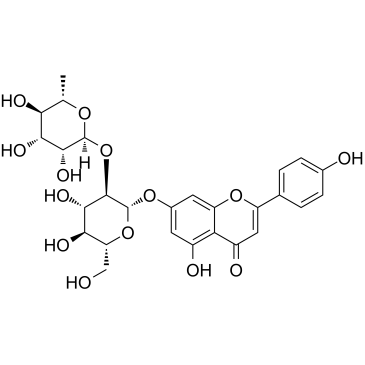
Rhoifolin structure
|
Common Name | Rhoifolin | ||
|---|---|---|---|---|
| CAS Number | 17306-46-6 | Molecular Weight | 578.519 | |
| Density | 1.7±0.1 g/cm3 | Boiling Point | 916.5±65.0 °C at 760 mmHg | |
| Molecular Formula | C27H30O14 | Melting Point | N/A | |
| MSDS | Chinese USA | Flash Point | 305.4±27.8 °C | |
Use of RhoifolinRhoifolin is a flavone glycoside isolated from Citrus grandis (L.) Osbeck leaves. Rhoifolin is beneficial for diabetic complications through enhanced adiponectin secretion, tyrosine phosphorylation of insulin receptor-β and glucose transporter 4 (GLUT 4) translocation[1]. Rhoifolin ameliorates titanium particle-stimulated osteolysis and attenuates osteoclastogenesis via RANKL-induced NF-κB and MAPK pathways[2]. |
Summary: Chinese name: Apigenin 7-O-neohesperidoside, English name: Rhoifolin, CAS number: 17306-46-6, molecular formula: C27H30O14, molecular weight: 578.519. For research-use only, not for medical or clinical usage.
This table lists Chinese names, IUPAC names and various aliases of this chemical substance.
| Name | apigenin 7-O-neohesperidoside |
|---|---|
| Synonym | More Synonyms |
This table contains bioactivity, target information and biological‑assay experimental data of this compound.
| Description | Rhoifolin is a flavone glycoside isolated from Citrus grandis (L.) Osbeck leaves. Rhoifolin is beneficial for diabetic complications through enhanced adiponectin secretion, tyrosine phosphorylation of insulin receptor-β and glucose transporter 4 (GLUT 4) translocation[1]. Rhoifolin ameliorates titanium particle-stimulated osteolysis and attenuates osteoclastogenesis via RANKL-induced NF-κB and MAPK pathways[2]. |
|---|---|
| Related Catalog | |
| Target |
NF-κB insulin receptor-β MAPK |
| References |
This table shows physicochemical parameters including melting point, boiling point, density, solubility and optical rotation. Missing data is marked as N/A.
| Density | 1.7±0.1 g/cm3 |
|---|---|
| Boiling Point | 916.5±65.0 °C at 760 mmHg |
| Molecular Formula | C27H30O14 |
| Molecular Weight | 578.519 |
| Flash Point | 305.4±27.8 °C |
| Exact Mass | 578.163574 |
| PSA | 228.97000 |
| LogP | 1.72 |
| Vapour Pressure | 0.0±0.3 mmHg at 25°C |
| Index of Refraction | 1.726 |
| InChIKey | RPMNUQRUHXIGHK-PYXJVEIZSA-N |
| SMILES | CC1OC(OC2C(Oc3cc(O)c4c(=O)cc(-c5ccc(O)cc5)oc4c3)OC(CO)C(O)C2O)C(O)C(O)C1O |
| Storage condition | 0-6°C |
This table provides MSDS information including hazard classification, first‑aid, fire‑fighting, spill handling, operation and storage instructions.
|
Section1. IDENTIFICATION OF THE SUBSTANCE/MIXTURE Product identifiers Product name: Apigenin 7-O-neohesperidoside CAS-No.: 17306-46-6 Relevant identified uses of the substance or mixture and uses advised against Identified uses: Laboratory chemicals, Manufacture of substances Section2. HAZARDS IDENTIFICATION Classification of the substance or mixture Not a hazardous substance or mixture according to Regulation (EC) No. 1272/2008. This substance is not classified as dangerous according to Directive 67/548/EEC. Label elements The product does not need to be labelled in accordance with EC directives or respective national laws. Other hazards - none Section3. COMPOSITION/INFORMATION ON INGREDIENTS Substances Formula: C27H30O14 Molecular Weight: 578,5 g/mol Section4. FIRST AID MEASURES Description of first aid measures If inhaled If breathed in, move person into fresh air. If not breathing, give artificial respiration. In case of skin contact Wash off with soap and plenty of water. In case of eye contact Flush eyes with water as a precaution. If swallowed Never give anything by mouth to an unconscious person. Rinse mouth with water. Most important symptoms and effects, both acute and delayed To the best of our knowledge, the chemical, physical, and toxicological properties have not been thoroughly investigated. Indication of any immediate medical attention and special treatment needed no data available Section5. FIREFIGHTING MEASURES Extinguishing media Suitable extinguishing media Use water spray, alcohol-resistant foam, dry chemical or carbon dioxide. Special hazards arising from the substance or mixture Carbon oxides Advice for firefighters Wear self contained breathing apparatus for fire fighting if necessary. Further information no data available Section6. ACCIDENTAL RELEASE MEASURES Personal precautions, protective equipment and emergency procedures Avoid dust formation. Avoid breathing vapors, mist or gas. Environmental precautions Do not let product enter drains. Methods and materials for containment and cleaning up Sweep up and shovel. Keep in suitable, closed containers for disposal. Reference to other sections For disposal see section 13. Section7. HANDLING AND STORAGE Precautions for safe handling Provide appropriate exhaust ventilation at places where dust is formed. Conditions for safe storage, including any incompatibilities Store in cool place. Keep container tightly closed in a dry and well-ventilated place. Specific end uses no data available Section8. EXPOSURE CONTROLS/PERSONAL PROTECTION Control parameters Components with workplace control parameters Exposure controls Appropriate engineering controls General industrial hygiene practice. Personal protective equipment Eye/face protection Use equipment for eye protection tested and approved under appropriate government standards such as NIOSH (US) or EN 166(EU). Skin protection Handle with gloves. Gloves must be inspected prior to use. Use proper glove removal technique (without touching glove's outer surface) to avoid skin contact with this product. Dispose of contaminated gloves after use in accordance with applicable laws and good laboratory practices. Wash and dry hands. The selected protective gloves have to satisfy the specifications of EU Directive 89/686/EEC and the standard EN 374 derived from it. Body Protection Choose body protection in relation to its type, to the concentration and amount of dangerous substances, and to the specific work-place., The type of protective equipment must be selected according to the concentration and amount of the dangerous substance at the specific workplace. Respiratory protection Respiratory protection is not required. Where protection from nuisance levels of dusts are desired, use type N95 (US) or type P1 (EN 143) dust masks. Use respirators and components tested and approved under appropriate government standards such as NIOSH (US) or CEN (EU). Section9. PHYSICAL AND CHEMICAL PROPERTIES Information on basic physical and chemical properties a) AppearanceForm: powder Colour: white, light yellow b) Odourno data available c) Odour Thresholdno data available d) pHno data available e) Melting point/freezingno data available point f) Initial boiling point and no data available boiling range g) Flash pointno data available h) Evaporation rateno data available i) Flammability (solid, gas) no data available j) Upper/lowerno data available flammability or explosive limits k) Vapour pressureno data available l) Vapour densityno data available m) Relative densityno data available n) Water solubilityno data available o) Partition coefficient: n- no data available octanol/water p) Autoignitionno data available temperature q) Decompositionno data available temperature r) Viscosityno data available s) Explosive propertiesno data available t) Oxidizing propertiesno data available Other safety information no data available Section10. STABILITY AND REACTIVITY Reactivity no data available Chemical stability no data available Possibility of hazardous reactions no data available Conditions to avoid no data available Incompatible materials no data available Hazardous decomposition products Other decomposition products - no data available Section11. TOXICOLOGICAL INFORMATION Information on toxicological effects Acute toxicity no data available Skin corrosion/irritation no data available Serious eye damage/eye irritation no data available Respiratory or skin sensitization no data available Germ cell mutagenicity no data available Carcinogenicity IARC:No component of this product present at levels greater than or equal to 0.1% is identified as probable, possible or confirmed human carcinogen by IARC. Reproductive toxicity no data available Specific target organ toxicity - single exposure no data available Specific target organ toxicity - repeated exposure no data available Aspiration hazard no data available Potential health effects Inhalation May be harmful if inhaled. May cause respiratory tract irritation. IngestionMay be harmful if swallowed. SkinMay be harmful if absorbed through skin. May cause skin irritation. EyesMay cause eye irritation. Signs and Symptoms of Exposure To the best of our knowledge, the chemical, physical, and toxicological properties have not been thoroughly investigated. Additional Information RTECS: Not available Section12. ECOLOGICAL INFORMATION Toxicity no data available Persistence and degradability no data available Bioaccumulative potential no data available Mobility in soil no data available Results of PBT and vPvB assessment no data available Other adverse effects no data available Section13. DISPOSAL CONSIDERATIONS Waste treatment methods Product Offer surplus and non-recyclable solutions to a licensed disposal company. Contaminated packaging Dispose of as unused product. Section14. TRANSPORT INFORMATION UN number ADR/RID: -IMDG: -IATA: - UN proper shipping name ADR/RID: Not dangerous goods IMDG: Not dangerous goods IATA:Not dangerous goods Transport hazard class(es) ADR/RID: -IMDG: -IATA: - Packaging group ADR/RID: -IMDG: -IATA: - Environmental hazards ADR/RID: noIMDG Marine pollutant: noIATA: no Special precautions for user no data available Section15. REGULATORY INFORMATION This safety datasheet complies with the requirements of Regulation (EC) No. 1907/2006. Safety, health and environmental regulations/legislation specific for the substance or mixture no data available Chemical Safety Assessment no data available Section16. OTHER INFORMATION Further information Copyright 2012 Co. LLC. License granted to make unlimited paper copies for internal use only. The above information is believed to be correct but does not purport to be all inclusive and shall be used only as a guide. The information in this document is based on the present state of our knowledge and is applicable to the product with regard to appropriate safety precautions. It does not represent any guarantee of the properties of the product. Corporation and its Affiliates shall not be held liable for any damage resulting from handling or from contact with the above product. See and/or the reverse side of invoice or packing slip for additional terms and conditions of sale. |
This table covers safety warnings, protective measures, incompatible substances and disposal guidelines for this compound.
| Personal Protective Equipment | Eyeshields;Gloves;type N95 (US);type P1 (EN143) respirator filter |
|---|---|
| Hazard Codes | Xi |
| Safety Phrases | 24/25 |
| RIDADR | NONH for all modes of transport |
| WGK Germany | 3 |
This table presents publicly reported synthetic routes, reaction conditions, reactants and product information of the compound.
|
~84%
Rhoifolin CAS#:17306-46-6 |
| Literature: Archiv der Pharmazie, , vol. 316, # 3 p. 219 - 222 |

This table lists relevant public references with title, journal and publication metadata for this compound.
|
Study on impurities in naringin extracted from Citrus grandis 'tomentosa'.
Zhong Yao Cai 35(1) , 56-61, (2012) To investigate the impurities in naringin extracted from Citrus grandis 'Tomentosa'.High performance liquid chromatographies coupled with photodiode array and electrospray ionization mass spectrometry... |
|
|
Determination of rhoifolin and daidzin in human plasma by high-performance liquid chromatography.
J. Chromatogr. B, Biomed. Appl. 655(2) , 300-4, (1994) A method for determining flavonoids in human plasma is presented for application to pharmacokinetic studies of two flavonoids, rhoifolin and daidzin. Isocratic reversed-phase high-performance liquid c... |
|
|
[Studies on antibacterial constituents of Discocleidion rufescens (2)].
Zhongguo Zhong Yao Za Zhi 34 , 1377-1380, (2009) To screen effective constituents of Discocleidion rufescens against bacteria.Compounds were isolated by bioassay-guided fractionation method with various chromatographic methods and their structures w... |
This table contains target information, in‑vitro & in‑vivo assay data for this compound.
|
Name: ERK5 transcriptional activity HTS
Source: 24565
Target: N/A
External Id: ERK5 transcriptional activity-HTS
|
|
Name: Screen for inhibitors of RMI FANCM (MM2) intereaction
Source: 11908
Target: N/A
External Id: RMI-FANCM-MM2
|
|
Name: Primary high throughput screening by co-culture imaging for identification hits as a ...
Source: 23209
Target: N/A
External Id: UIHTS20180925
|
|
Name: Antioxidant activity assessed as inhibition of AAPH-induced hemolysis in rat RBC afte...
Source: ChEMBL
Target: NON-PROTEIN TARGET
External Id: CHEMBL992960
|
|
Name: Spectrum HTS for Inhibitors of Aerobactin Synthetase IucA
Source: 23265
Target: IucA Synthetase from hypervirulent Klebsiella pneumoniae hvKP1
External Id: IucA Pilot Assay Spectrum Library
|
|
Name: Inhibition of sodium fluorescein uptake in OATP1B3-transfected CHO cells at an equimo...
Source: ChEMBL
Target: Solute carrier organic anion transporter family member 1B3
External Id: CHEMBL3039491
|
|
Name: Inhibition of COX2 at 2.5 ug/mL
Source: ChEMBL
Target: Prostaglandin G/H synthase 2
External Id: CHEMBL1008559
|
|
Name: The chemical genetic matrix (CGM) dataset as reported in Wildenhain et al. (2015) Pre...
Source: 11924
Target: N/A
External Id: CGM data for Cell Systems paper Dec 2015
|
This table collects all English aliases, systematic names and CAS‑related synonyms of the compound.
| Apigenin-7-O-neohesperidoside |
| Apigenin-7-neohesperidoside |
| RHOIFOLOSIDE |
| 7-{[(2S,3R,4S,5S,6R)-4,5-Dihydroxy-6-(hydroxymethyl)-3-{[(2S,3R,4R,5R,6S)-3,4,5-trihydroxy-6-methyltetrahydro-2H-pyran-2-yl]oxy}tetrahydro-2H-pyran-2-yl]oxy}-5-hydroxy-2-(4-hydroxyphenyl)-4H-chromen-4-on |
| 7-{[(2S,3R,4S,5S,6R)-4,5-Dihydroxy-6-(hydroxyméthyl)-3-{[(2S,3R,4R,5R,6S)-3,4,5-trihydroxy-6-méthyltétrahydro-2H-pyran-2-yl]oxy}tétrahydro-2H-pyran-2-yl]oxy}-5-hydroxy-2-(4-hydroxyphényl)-4H-chromén-4-one |
| Apigenin 7-O-neo-hesperidoside |
| 5-Hydroxy-2-(4-hydroxyphenyl)-4-oxo-4H-chromen-7-yl 2-O-(6-deoxy-a-L-mannopyranosyl)-b-D-glucopyranoside |
| 5-Hydroxy-2-(4-hydroxyphenyl)-4-oxo-4H-chromen-7-yl-2-O-(6-deoxy-α-L-mannopyranosyl)-β-D-glucopyranoside |
| apigenin 7-O-neohesperidoside |
| Rhoifolin |
| Apigenin-7-rhamnoglucoside |
| 5-Hydroxy-2-(4-hydroxyphenyl)-4-oxo-4H-chromen-7-yl 2-O-(6-deoxy-α-L-mannopyranosyl)-β-D-glucopyranoside |
| 7-{[(2S,3R,4S,5S,6R)-4,5-Dihydroxy-6-(hydroxymethyl)-3-{[(2S,3R,4R,5R,6S)-3,4,5-trihydroxy-6-methyltetrahydro-2H-pyran-2-yl]oxy}tetrahydro-2H-pyran-2-yl]oxy}-5-hydroxy-2-(4-hydroxyphenyl)-4H-chromen-4-one |
This section contains frequently‑asked‑questions about this compound, including basic parameters, properties, storage conditions and corresponding answers.
| Q: What is the InChIKey of apigenin 7-O-neohesperidoside? |
| A: InChIKey of apigenin 7-O-neohesperidoside is RPMNUQRUHXIGHK-PYXJVEIZSA-N. |
| Q: What is the English name of apigenin 7-O-neohesperidoside? |
| A: The English name of apigenin 7-O-neohesperidoside is apigenin 7-O-neohesperidoside. |
| Q: What is the safety information for apigenin 7-O-neohesperidoside? |
| A: Safety information for apigenin 7-O-neohesperidoside: 24/25. |
| Q: What is the LogP of apigenin 7-O-neohesperidoside? |
| A: LogP of apigenin 7-O-neohesperidoside is 1.72. |
| Q: What is the CAS number of apigenin 7-O-neohesperidoside? |
| A: CAS number of apigenin 7-O-neohesperidoside is 17306-46-6. |
| Q: What is the polar surface area (PSA) of apigenin 7-O-neohesperidoside? |
| A: Polar surface area (PSA) of apigenin 7-O-neohesperidoside is 228.97000. |
| Q: What is the boiling point of apigenin 7-O-neohesperidoside? |
| A: Boiling point of apigenin 7-O-neohesperidoside is 916.5±65.0 °C at 760 mmHg. |
| Q: What is the molecular weight of apigenin 7-O-neohesperidoside? |
| A: Molecular weight of apigenin 7-O-neohesperidoside is 578.519. |
| Q: What are the storage conditions for apigenin 7-O-neohesperidoside? |
| A: Storage conditions for apigenin 7-O-neohesperidoside: 0-6°C. |
| Q: What is the SMILES notation of apigenin 7-O-neohesperidoside? |
| A: SMILES notation of apigenin 7-O-neohesperidoside is CC1OC(OC2C(Oc3cc(O)c4c(=O)cc(-c5ccc(O)cc5)oc4c3)OC(CO)C(O)C2O)C(O)C(O)C1O. |
This table lists manufacturers and suppliers of this compound, including vendor names and product supply reference information.
| Shanghai Nianxing Industrial Co., Ltd |
| BioBioPha |
| naturewill |