677331-12-3
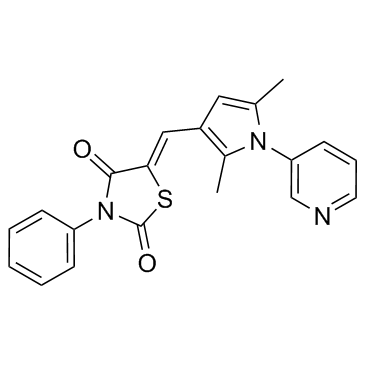
677331-12-3 structure
- Name: iCRT-14
- Chemical Name: (5Z)-5-[(2,5-dimethyl-1-pyridin-3-ylpyrrol-3-yl)methylidene]-3-phenyl-1,3-thiazolidine-2,4-dione
- CAS Number: 677331-12-3
- Molecular Formula: C21H17N3O2S
- Molecular Weight: 375.44400
- Catalog: Signaling Pathways Stem Cell/Wnt Wnt
- Create Date: 2017-01-24 04:15:52
- Modify Date: 2026-07-01 11:59:01
-
iCRT 14 is a novel potent inhibitor of β-catenin-responsive transcription (CRT), with IC50 of 40.3 nM against Wnt responsive STF16 luciferase.
| Name | (5Z)-5-[(2,5-dimethyl-1-pyridin-3-ylpyrrol-3-yl)methylidene]-3-phenyl-1,3-thiazolidine-2,4-dione |
|---|---|
| Synonyms |
iCRT14,iCRT-14,Wnt,Inhibitor,iCRT 14,inhibit
5-[[2,5-DiMethyl-1-(3-pyridinyl)-1H-pyrrol-3-yl]Methylene]-3-phenyl-2,4-thiazolidinedione ICRT14;ICRT-14 5-((2,5-Dimethyl-1-(pyridin-3-yl)-1H-pyrrol-3-yl)methylene)-3-phenylthiazolidine-2,4-dione 2,4-Thiazolidinedione, 5-[[2,5-dimethyl-1-(3-pyridinyl)-1H-pyrrol-3-yl]methylene]-3-phenyl 1-[3-(1-hydroperoxy-1-methylethyl)phenyl]-ethanone iCRT 14, 10 mM in DMSO iCRT 14 iCRT14 ,S8704 iCRT14 |
| Description | iCRT 14 is a novel potent inhibitor of β-catenin-responsive transcription (CRT), with IC50 of 40.3 nM against Wnt responsive STF16 luciferase. |
|---|---|
| Related Catalog | |
| Target |
IC50: 40.3 nM (Wnt responsive STF16 luciferase)[1] |
| In Vitro | iCRT14 can interfere with TCF binding to DNA in addition to its ability to influence TCF-β-cat interaction[1]. iCRT14 (10, 25, 50 μM) effectively inhibits cell proliferation in BT-549 cells in a dose- and time-dependent manner, but still less potent than iCRT3[2]. |
| In Vivo | iCRT14 (50 mg/kg, i.p.) markedly decreases CycD1, proliferation of the tumors in HCT116 xenografts[1]. |
| Cell Assay | Cells are seeded at 20,000 cells/well into 96-well plates. After overnight incubation, cells are treated with DMSO or each Wnt inhibitor (iCRT-3, 75 μM; iCRT-5, 200 μM; iCRT-14, 50 μM; IWP-4, 5 μM and XAV-939, 10 μM) for 48 hours. Cell viability is determined using the Cell Titer-Glo luminescent cell viability assay kit. Luminescence is measured using FLUOstar microplate reader. All treatments are performed in triplicate, and each experiment is repeated three times. |
| References |
| Molecular Formula | C21H17N3O2S |
|---|---|
| Molecular Weight | 375.44400 |
| Exact Mass | 375.10400 |
| PSA | 80.50000 |
| LogP | 4.79500 |
| Storage condition | 2-8°C |
