1043444-18-3
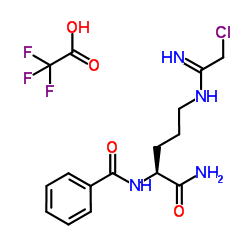
1043444-18-3 structure
- Name: Cl-amidine TFA
- Chemical Name: N-{(2S)-1-Amino-5-[(2-chloroethanimidoyl)amino]-1-oxo-2-pentanyl}benzamide trifluoroacetate (1:1)
- CAS Number: 1043444-18-3
- Molecular Formula: C16H20ClF3N4O4
- Molecular Weight: 424.803
- Catalog: Signaling Pathways Apoptosis Apoptosis
- Create Date: 2018-04-08 00:57:27
- Modify Date: 2026-07-16 17:03:05
-
Cl-amidine TFA is an orally active peptidylarginine deminase (PAD) inhibitor, with IC50 values of 0.8 μM, 6.2 μM and 5.9 μM for PAD1, PAD3, and PAD4, respectively. Cl-amidine TFA induces apoptosis in cancer cells. Cl-amidine TFA induces microRNA (miR)-16 expression and causes cell cycle arrest. Cl-Amidine TFA prevents histone 3 citrullination and neutrophil extracellular trap formation, and improves survival in a murine sepsis model[1][2][3][4][5].
| Name | N-{(2S)-1-Amino-5-[(2-chloroethanimidoyl)amino]-1-oxo-2-pentanyl}benzamide trifluoroacetate (1:1) |
|---|---|
| Synonyms |
(2S)-5-(2-Chloroethanimidamido)-2-(phenylformamido)pentanamide trifluoroacetic acid salt
Cl-amidine Acetic acid, 2,2,2-trifluoro-, compd. with N-[(1S)-1-(aminocarbonyl)-4-[(2-chloro-1-iminoethyl)amino]butyl]benzamide (1:1) Cl-Amidine (trifluoroacetate salt) |
| Description | Cl-amidine TFA is an orally active peptidylarginine deminase (PAD) inhibitor, with IC50 values of 0.8 μM, 6.2 μM and 5.9 μM for PAD1, PAD3, and PAD4, respectively. Cl-amidine TFA induces apoptosis in cancer cells. Cl-amidine TFA induces microRNA (miR)-16 expression and causes cell cycle arrest. Cl-Amidine TFA prevents histone 3 citrullination and neutrophil extracellular trap formation, and improves survival in a murine sepsis model[1][2][3][4][5]. |
|---|---|
| Related Catalog | |
| Target |
IC50: 0.8 μM (PAD1), 5.9 μM (PAD4), 6.2 μM (PAD3)[1][5]. |
| In Vitro | Cl-amidine is a bioavailable haloacetamidine-based compound that inhibits all the active PAD isozymes with near equal potency (kinact/KI=13,000 M-1•min-1 for PAD4)[1]. Cl-amidine (0, 5, 10, 15, 20, 25, 50 μg/mL, 24 hours) induces apoptosis in TK6 lymphoblastoid cells and HT29 colon cancer cells in a dose-dependent manner. Interestingly, the colon cancer cell line (HT29) is relatively resistant to apoptosis caused by Cl-amidine[2]. Cl-amidine irreversibly inactivates PADs by covalently modifying an active site cysteine that is important for its catalytic activity[4]. Apoptosis Analysis[2]. Cell Line: TK6 lymphoblastoid cells and HT29 colon cancer cells. Concentration: 0, 5, 10, 15, 20, 25, 50 μg/mL. Incubation Time: 24 h. Result: Induced apoptosis dose-dependently. |
| In Vivo | Cl-amidine (75 mg/kg, ip once daily) suppresses and treats DSS-induced colitis in mice[2]. Cl-amidine (5, 25, 75 mg/kg, oral gavage, once daily) leads to significant reductions in the histology scores dose-dependently[2]. Animal Model: C57BL/6 mice (8-12 wk old, DSS mouse model of colitis)[2]. Dosage: 75 mg/kg. Administration: IP once daily. Result: Suppressed PAD activity, protein citrullination, and PAD levels in the colon in vivo. Animal Model: C57BL/6 mice (8-12 wk old, DSS mouse model of colitis)[2]. Dosage: 5, 25, 75 mg/kg. Administration: Oral gavage once daily. Result: Led to significant reductions in the histology scores. |
| References |
| Molecular Formula | C16H20ClF3N4O4 |
|---|---|
| Molecular Weight | 424.803 |
| Exact Mass | 424.112518 |
| Storage condition | -20℃ |
| Hazard Codes | N |
|---|