916232-21-8
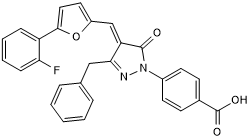
916232-21-8 structure
- Name: GS143
- Chemical Name: GS-143
- CAS Number: 916232-21-8
- Molecular Formula: C28H19FN2O4
- Molecular Weight: 466.5
- Catalog: Signaling Pathways Metabolic Enzyme/Protease E1/E2/E3 Enzyme
- Create Date: 2020-09-24 18:02:04
- Modify Date: 2026-07-01 18:48:23
-
GS143 is a selective IκBα ubiquitination inhibitor with an IC50 of 5.2 μM for SCFβTrCP1-mediated IκBα ubiquitylation. GS143 suppresses NF-κB activation and transcription of target genes and does not inhibit proteasome activity. GS143 has anti-asthma effect[1][2].
| Name | GS-143 |
|---|---|
| Synonyms |
Benzoic acid, 4-[4-[[5-(2-fluorophenyl)-2-furanyl]methylene]-4,5-dihydro-5-oxo-3-(phenylmethyl)-1H-pyrazol-1-yl]
E2 conjugating enzyme,inhibit,IκBα,Th2,Ubiquitin conjugating enzyme,GS143,Ubiquitin ligase,IL-4,IκB kinase,βTr1,Nuclefactor-kappaB,eosinophil,Ubiquitin activating enzyme,Nuclefactor-κB,I kappa B kinase,NF-κB,E3 ligating enzyme,IKK,E1 activating enzyme,anti-asthma,E1/E2/E3 Enzyme,ubiquitination,Inhibitor,airway,inflammation GS143, 10 mM in DMSO 4-(3-Benzyl-4-{[5-(2-fluorophenyl)furan-2-yl]methylidene}-5-oxo-4,5-dihydro-1H-pyrazol-1-yl)benzoic acid IκB Ubiquitination Inhibitor, GS143 MFCD30182334 4-[4-[[5-(2-Fluorophenyl)-2-furanyl]methylene]-4,5-dihydro-5-oxo-3-(phenylmethyl)-1H-pyrazol-1-yl]benzoic acid |
| Description | GS143 is a selective IκBα ubiquitination inhibitor with an IC50 of 5.2 μM for SCFβTrCP1-mediated IκBα ubiquitylation. GS143 suppresses NF-κB activation and transcription of target genes and does not inhibit proteasome activity. GS143 has anti-asthma effect[1][2]. |
|---|---|
| Related Catalog | |
| Target |
IC50: 5.2 μM (SCFβTrCP1-mediated IκBα ubiquitylation)[2] |
| In Vitro | GS143 (10 μM or 20 μM) inhibits antigen-induced differentiation of Th2 cells but not of Th1 cells in vitro. The IL-4 production in Th2-polarizing condition is markedly suppressed by GS143 in a dose-dependent manner[1]. GS143 suppresses the transcription of TNFα-induced NF-κB with a mean IC50 value of 10.5 μM. GS143 also inhibits TNFα-induced expression of ICAM-1 in HT-29 colon cancer cells with an IC50 value of 6.1 μM. The production levels of TNFα and IL-1β in LPS-activated THP-1 cells are inhibited with IC50 values of 5.3 μM and 2.1 μM, respectively. GS143 does not inhibit p53 and β-catenin[2]. |
| In Vivo | GS143 (16-32 μg/body; intranasal administration; once; BALB/c mice) treatment suppresses antigen-induced NF-κB activation in the lung of sensitized mice. GS143 treatment also inhibits antigen-induced eosinophil and lymphocyte recruitment into the airways and the expression of Th2 cytokines and eotaxin in the airways[1]. Animal Model: BALB/c mice (age 7-8weeks) injected with ovalbumin[1] Dosage: 16 μg/body or 32 μg/body Administration: Intranasal administration; once Result: Suppressed antigen-induced NF-κB activation in the lung of sensitized mice. |
| References |
| Molecular Formula | C28H19FN2O4 |
|---|---|
| Molecular Weight | 466.5 |
| Appearance | A crystalline solid |
| Storage condition | Store at +4°C |
| Hazard Codes | Xi |
|---|