Hirsutenone
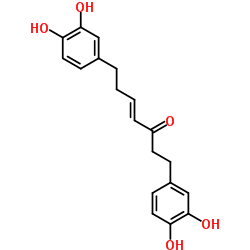
Hirsutenone structure
|
Common Name | Hirsutenone | ||
|---|---|---|---|---|
| CAS Number | 41137-87-5 | Molecular Weight | 328.359 | |
| Density | 1.3±0.1 g/cm3 | Boiling Point | 622.0±55.0 °C at 760 mmHg | |
| Molecular Formula | C19H20O5 | Melting Point | N/A | |
| MSDS | Chinese USA | Flash Point | 344.0±28.0 °C | |
| Symbol |

GHS09 |
Signal Word | Warning | |
Use of HirsutenoneHirsutenone is an active botanical diarylheptanoid present in Alnus species and exhibits many biological activities, including anti-inflammatory, anti-tumor promoting and anti-atopic dermatitis effects. Hirsutenone attenuates adipogenesis by binding directly to PI3K and ERK1 in a non-ATP competitive manner. Hirsutenone can be used for the study of obesity[1]. |
This table lists Chinese names, IUPAC names and various aliases of this chemical substance.
| Name | (4E)-1,7-Bis(3,4-dihydroxyphenyl)-4-hepten-3-one |
|---|---|
| Synonym | More Synonyms |
This table contains bioactivity, target information and biological‑assay experimental data of this compound.
| Description | Hirsutenone is an active botanical diarylheptanoid present in Alnus species and exhibits many biological activities, including anti-inflammatory, anti-tumor promoting and anti-atopic dermatitis effects. Hirsutenone attenuates adipogenesis by binding directly to PI3K and ERK1 in a non-ATP competitive manner. Hirsutenone can be used for the study of obesity[1]. |
|---|---|
| Related Catalog | |
| In Vitro | Hirsutenone (0-100 μM; 48 hours) inhibits adipogenesis in 3T3-L1 preadipocytes and exhibits non-toxicity at 20-100 μM[1]. Hirsutenone (0-100 μM; 48 hours) attenuates MDI-induced lipid accumulation in 3T3-L1 preadipocytes in a dose-dependent manner. In particular, HST at 40 and 80 μM significantly reduces MDI-induced adipogenesis in 3T3-L1 preadipocytes[1]. Hirsutenone (0-100 μM; 48 hours) reduces the protein expression levels of PPARg, C/EBPa, and FAS in a dose-dependent manner in 3T3-L1 preadipocytes[1]. Hirsutenone (80 μM; 20-24 hours) suppresses the cell cycle entry to S and G2/M phases occurrs at 20 hours when compares with at 20 hours. At 24 h, more cells are arrested in G1 phase (53% of total cells) when compares with the MDI-induced group which contains the majority of cells (56% of total cells) in G2/M phase[1]. |
| References |
This table shows physicochemical parameters including melting point, boiling point, density, solubility and optical rotation. Missing data is marked as N/A.
| Density | 1.3±0.1 g/cm3 |
|---|---|
| Boiling Point | 622.0±55.0 °C at 760 mmHg |
| Molecular Formula | C19H20O5 |
| Molecular Weight | 328.359 |
| Flash Point | 344.0±28.0 °C |
| Exact Mass | 328.131073 |
| PSA | 97.99000 |
| LogP | 2.16 |
| Vapour Pressure | 0.0±1.9 mmHg at 25°C |
| Index of Refraction | 1.649 |
| InChIKey | VWHYFMQKJYFLCC-DUXPYHPUSA-N |
| SMILES | O=C(C=CCCc1ccc(O)c(O)c1)CCc1ccc(O)c(O)c1 |
| Storage condition | ?20°C |
This table provides MSDS information including hazard classification, first‑aid, fire‑fighting, spill handling, operation and storage instructions.
This table covers safety warnings, protective measures, incompatible substances and disposal guidelines for this compound.
| Symbol |
GHS09 |
|---|---|
| Signal Word | Warning |
| Hazard Statements | H410 |
| Precautionary Statements | P273-P501 |
| Hazard Codes | N |
| Risk Phrases | 50 |
| Safety Phrases | 61 |
| RIDADR | UN 3077 9 / PGIII |
| HS Code | 2914501900 |
This table presents publicly reported synthetic routes, reaction conditions, reactants and product information of the compound.
|
~%
Hirsutenone CAS#:41137-87-5 |
| Literature: Venkateswarlu; Ramachandra; Rambabu; Subbaraju Indian Journal of Chemistry - Section B Organic and Medicinal Chemistry, 2001 , vol. 40, # 6 p. 495 - 497 |
|
~%
Hirsutenone CAS#:41137-87-5 |
| Literature: Venkateswarlu; Ramachandra; Rambabu; Subbaraju Indian Journal of Chemistry - Section B Organic and Medicinal Chemistry, 2001 , vol. 40, # 6 p. 495 - 497 |
|
~%
Hirsutenone CAS#:41137-87-5 |
| Literature: Venkateswarlu; Ramachandra; Rambabu; Subbaraju Indian Journal of Chemistry - Section B Organic and Medicinal Chemistry, 2001 , vol. 40, # 6 p. 495 - 497 |
|
~%
Hirsutenone CAS#:41137-87-5 |
| Literature: Park, Daae; Kim, Hyoung Ja; Jung, Seo Yun; Yook, Chang-Soo; Jin, Changbae; Lee, Yong Sup Chemical and Pharmaceutical Bulletin, 2010 , vol. 58, # 2 p. 238 - 241 |
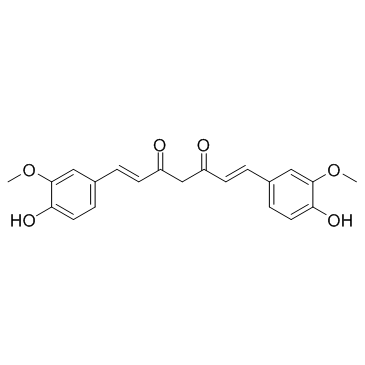

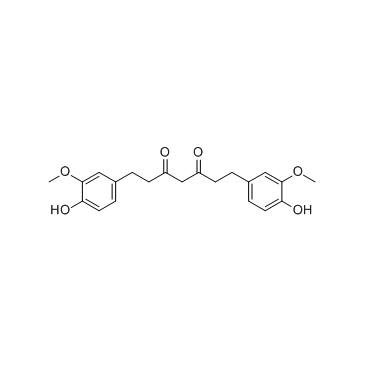
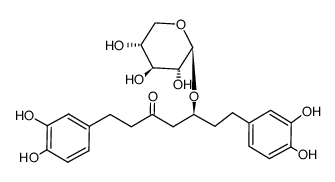

This table lists upstream starting materials and downstream derivative products related to this chemical.
| Precursor 4 | |
|---|---|
| DownStream 0 | |
This table shows customs‑related data including HS‑code, tariff and regulatory conditions for import and export.
| HS Code | 2914501900 |
|---|---|
| Summary | 2914501900 other ketone-phenols。Supervision conditions:None。VAT:17.0%。Tax rebate rate:9.0%。MFN tariff:5.5%。General tariff:30.0% |
This table contains target information, in‑vitro & in‑vivo assay data for this compound.
This table collects all English aliases, systematic names and CAS‑related synonyms of the compound.
| chikusetsusaponinivc |
| Panaxoside |
| hirsutanone |
| Ginsenoside Re std. |
| gingerenone-A |
| gingenoside Re |
| ginsenoside-Re standard |
| ginsenoside-Re |
| (4E)-1,7-Bis(3,4-dihydroxyphenyl)hept-4-en-3-one |
| GINSENOSIDE GINSENOSIDE-RE |
| (4E)-1,7-Bis(3,4-dihydroxyphenyl)-4-hepten-3-one |
| 1,7-Bis-(3,4-dihydroxy-phenyl)-hept-4-en-3-one |
| ginsenosideb2 |
| Hirsutenone |
This section contains frequently‑asked‑questions about this compound, including basic parameters, properties, storage conditions and corresponding answers.
| Q: What is the safety information for (4E)-1,7-Bis(3,4-dihydroxyphenyl)-4-hepten-3-one? |
| A: Safety information for (4E)-1,7-Bis(3,4-dihydroxyphenyl)-4-hepten-3-one: 61. |
| Q: What is the InChIKey of (4E)-1,7-Bis(3,4-dihydroxyphenyl)-4-hepten-3-one? |
| A: InChIKey of (4E)-1,7-Bis(3,4-dihydroxyphenyl)-4-hepten-3-one is VWHYFMQKJYFLCC-DUXPYHPUSA-N. |
| Q: What is the boiling point of (4E)-1,7-Bis(3,4-dihydroxyphenyl)-4-hepten-3-one? |
| A: Boiling point of (4E)-1,7-Bis(3,4-dihydroxyphenyl)-4-hepten-3-one is 622.0±55.0 °C at 760 mmHg. |
| Q: What are the uses of (4E)-1,7-Bis(3,4-dihydroxyphenyl)-4-hepten-3-one? |
| A: Main uses of (4E)-1,7-Bis(3,4-dihydroxyphenyl)-4-hepten-3-one: Hirsutenone is an active botanical diarylheptanoid present in Alnus species and exhibits many biological activities, including anti-inflammatory, anti-tumor promoting and anti-atopic dermatitis effects. Hirsutenone attenuates adipogenesis by binding directly to PI3K and ERK1 in a non-ATP competitive manner. Hirsutenone can be used for the study of obesity[1]. |
| Q: What is the English name of (4E)-1,7-Bis(3,4-dihydroxyphenyl)-4-hepten-3-one? |
| A: The English name of (4E)-1,7-Bis(3,4-dihydroxyphenyl)-4-hepten-3-one is (4E)-1,7-Bis(3,4-dihydroxyphenyl)-4-hepten-3-one. |
| Q: What is the molecular weight of (4E)-1,7-Bis(3,4-dihydroxyphenyl)-4-hepten-3-one? |
| A: Molecular weight of (4E)-1,7-Bis(3,4-dihydroxyphenyl)-4-hepten-3-one is 328.359. |
| Q: What is the molecular formula of (4E)-1,7-Bis(3,4-dihydroxyphenyl)-4-hepten-3-one? |
| A: Molecular formula of (4E)-1,7-Bis(3,4-dihydroxyphenyl)-4-hepten-3-one is C19H20O5. |
| Q: What are the storage conditions for (4E)-1,7-Bis(3,4-dihydroxyphenyl)-4-hepten-3-one? |
| A: Storage conditions for (4E)-1,7-Bis(3,4-dihydroxyphenyl)-4-hepten-3-one: ?20°C. |
| Q: What is the CAS number of (4E)-1,7-Bis(3,4-dihydroxyphenyl)-4-hepten-3-one? |
| A: CAS number of (4E)-1,7-Bis(3,4-dihydroxyphenyl)-4-hepten-3-one is 41137-87-5. |
| Q: What is the polar surface area (PSA) of (4E)-1,7-Bis(3,4-dihydroxyphenyl)-4-hepten-3-one? |
| A: Polar surface area (PSA) of (4E)-1,7-Bis(3,4-dihydroxyphenyl)-4-hepten-3-one is 97.99000. |
This table lists manufacturers and suppliers of this compound, including vendor names and product supply reference information.
| Shanghai Nianxing Industrial Co., Ltd |
| BioBioPha |
| Dayang Chem (Hangzhou) Co., Ltd. |