Damnacanthal
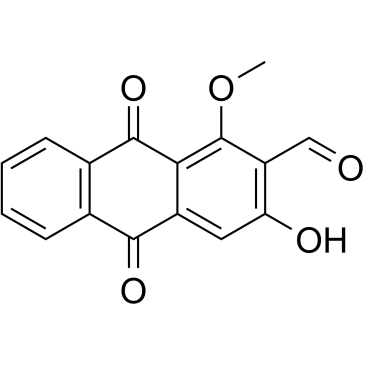
Damnacanthal structure
|
Common Name | Damnacanthal | ||
|---|---|---|---|---|
| CAS Number | 477-84-9 | Molecular Weight | 282.248 | |
| Density | 1.5±0.1 g/cm3 | Boiling Point | 531.9±50.0 °C at 760 mmHg | |
| Molecular Formula | C16H10O5 | Melting Point | N/A | |
| MSDS | N/A | Flash Point | 204.9±23.6 °C | |
Use of DamnacanthalDamnacanthal is an anthraquinone isolated from the root of Morinda citrifolia. Damnacanthal is a highly potent, selective inhibitor of p56lck tyrosine kinase activity. Natural Damnacanthal inhibits p56 lck autophosphorylation and phosphorylation of exogenous substrates with IC50s of 46 nM and 220 nM, respectively. Damnacanthal is a potent inducer of apoptosis with anticancer activity. Damnacanthal also has antinociceptive, anti-inflammatory effects in mice and anti-fungal activity against Candida albicans[1][2][3][4]. |
This table lists Chinese names, IUPAC names and various aliases of this chemical substance.
| Name | Damnacanthal |
|---|---|
| Synonym | More Synonyms |
This table contains bioactivity, target information and biological‑assay experimental data of this compound.
| Description | Damnacanthal is an anthraquinone isolated from the root of Morinda citrifolia. Damnacanthal is a highly potent, selective inhibitor of p56lck tyrosine kinase activity. Natural Damnacanthal inhibits p56 lck autophosphorylation and phosphorylation of exogenous substrates with IC50s of 46 nM and 220 nM, respectively. Damnacanthal is a potent inducer of apoptosis with anticancer activity. Damnacanthal also has antinociceptive, anti-inflammatory effects in mice and anti-fungal activity against Candida albicans[1][2][3][4]. |
|---|---|
| Related Catalog | |
| Target |
IC50: 46 nM (p56 lck autophosphorylation) and 220 nM (phosphorylation of exogenous substrates by p56 lck)[1]; Apoptosis[2]; Candida albicans[2] |
| In Vitro | Damnacanthal has > 100-fold selectivity for p56lck over the serine/threonine kinases, protein kinase A and protein kinase C, and > 40-fold selectivity for p56lck over four receptor tyrosine kinases. Damnacanthal also demonstrates modest (7-20-fold), but highly statistically significant, selectivity for p56lck over the homologous enzymes p60src and p59fyn[1]. Damnacanthal (0.1-100 μM; 1-4 days; HCT-116 and SW480 cells) treatment results in a significant reduction of cell proliferation in a concentration- and time-dependent manner[2]. Damnacanthal (1-50 μM; 72 hours; HCT-116 cells) treatment results in a significant enrichment in the number of cells in the S/G1 and G2/G1 phases at concentration of 50 μM[2]. Damnacanthal (10 μM; 24 hours; HCT-116 cells) treatment significantly increases caspase 3/7 activity. Damnacanthal-induced apoptosis[2]. Damnacanthal (0.1-10 μM; 24 hours; HCT-116 cells) treatment induces NAG-1 expression in HCT-116 cells. Cyclin D1 expression is reduced at 10 μM of Damnacanthal, whereas p21 and p53 does not alter their expression. PARP cleavage is seen at 10 μM Damnacanthal treatment only in HCT-116 cells, where NAG-1 is induced[2]. Damnacanthal treatment for 2 weeks shows significant decreasing colony number in HCT-116 cells in a concentration-dependent manner. Damnacanthal-treated cells show a dramatic inhibition of clonogenic capacity. Damnacanthal-treated (1-50 μM; 48 hours) cells significantly inhibits the migration of HCT-116 cells in a concentration-dependent manner[2]. Cell Proliferation Assay[2] Cell Line: HCT-116 and SW480 cells Concentration: 0.1 μM, 1 μM, 10 μM, 100 μM Incubation Time: 1, 2, and 4 days Result: Resulted in a significant reduction of cell proliferation in a concentration- and time-dependent manner. Cell Cycle Analysis[2] Cell Line: HCT-116 cells Concentration: 1 μM, 10 μM and 50 μM Incubation Time: 72 hours Result: Resulted in a significant enrichment in the number of cells in the S/G1 and G2/G1 phases at concentration of 50 μM. Apoptosis Analysis[2] Cell Line: HCT-116 cells Concentration: 10 μM Incubation Time: 24 hours Result: Significantly increased caspase 3/7 activity. Western Blot Analysis[2] Cell Line: HCT-116 cells Concentration: 0.1 μM, 1 μM and 10 μM Incubation Time: 24 hours Result: NAG-1 was induced in HCT-116 cells in a dose- and time-dependent manner. Cyclin D1 expression was reduced at 10 μM. |
| In Vivo | Damnacanthal (10-100 mg/kg; oral administration; for 10-300 minutes; male ddY mice) treatment exhibits a significant antinociceptive effect in a dose-dependent manner in the formalin test. Administration of damnacanthal (100 mg/kg) shows significant inhibition of histamine-induced paw edema[4]. Animal Model: Male ddY mice (5-6 weeks) injected with formalin or Histamine[4] Dosage: 10 mg/kg, 30 mg/kg and 100 mg/kg Administration: Oral administration; for 10 minutes, 30 minutes, 60 minutes or 300 minutes Result: Significantly reduced the growth of human lung tumor without acute toxicity. |
| References |
This table shows physicochemical parameters including melting point, boiling point, density, solubility and optical rotation. Missing data is marked as N/A.
| Density | 1.5±0.1 g/cm3 |
|---|---|
| Boiling Point | 531.9±50.0 °C at 760 mmHg |
| Molecular Formula | C16H10O5 |
| Molecular Weight | 282.248 |
| Flash Point | 204.9±23.6 °C |
| Exact Mass | 282.052826 |
| PSA | 80.67000 |
| LogP | 3.74 |
| Vapour Pressure | 0.0±1.5 mmHg at 25°C |
| Index of Refraction | 1.692 |
| InChIKey | IPDMWUNUULAXLU-UHFFFAOYSA-N |
| SMILES | COc1c(C=O)c(O)cc2c1C(=O)c1ccccc1C2=O |
| Storage condition | 2-8℃ |
This table covers safety warnings, protective measures, incompatible substances and disposal guidelines for this compound.
| Hazard Codes | Xi |
|---|
This table presents publicly reported synthetic routes, reaction conditions, reactants and product information of the compound.
This table lists upstream starting materials and downstream derivative products related to this chemical.
| Precursor 9 | |
|---|---|
| DownStream 3 | |
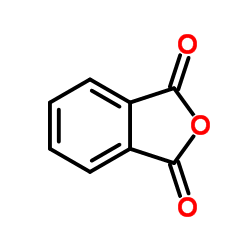 CAS#:85-44-9
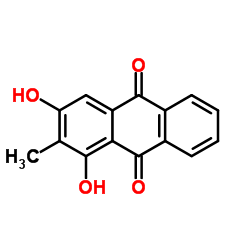 CAS#:117-02-2
 CAS#:10383-64-9
 CAS#:2324-25-6
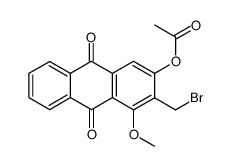 CAS#:63965-55-9
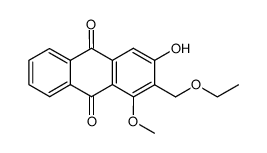 CAS#:63965-57-1
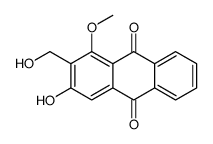 CAS#:477-83-8
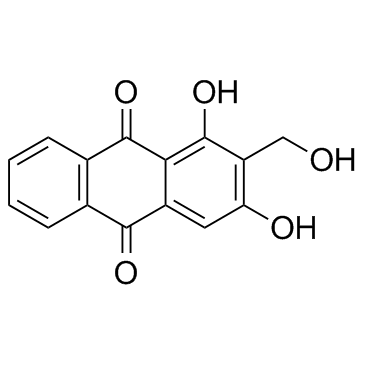 CAS#:478-08-0
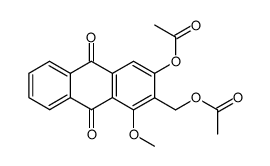 CAS#:63965-56-0
 CAS#:3736-59-2
 CAS#:478-06-8
This table contains target information, in‑vitro & in‑vivo assay data for this compound.
This table collects all English aliases, systematic names and CAS‑related synonyms of the compound.
| 3-hydroxy-1-methoxy-9,10-dioxoanthracene-2-carbaldehyde |
| 3-Hydroxy-1-methoxy-9,10-dioxo-9,10-dihydro-2-anthracenecarbaldehyde |
| Damnacanthal |
| 3-Hydroxy-1-methoxy-9,10-dioxo-9,10-dihydro-anthracene-2-carbaldehyde |
| 3-Hydroxy-1-methoxy-9,10-dioxo-9,10-dihydroanthracene-2-carbaldehyde |
This section contains frequently‑asked‑questions about this compound, including basic parameters, properties, storage conditions and corresponding answers.
| Q: What is the molecular formula of Damnacanthal? |
| A: Molecular formula of Damnacanthal is C16H10O5. |
| Q: What is the polar surface area (PSA) of Damnacanthal? |
| A: Polar surface area (PSA) of Damnacanthal is 80.67000. |
| Q: What is the boiling point of Damnacanthal? |
| A: Boiling point of Damnacanthal is 531.9±50.0 °C at 760 mmHg. |
| Q: What is the molecular weight of Damnacanthal? |
| A: Molecular weight of Damnacanthal is 282.248. |
| Q: What are the upstream materials of Damnacanthal? |
| A: Related upstream materials(CAS) of Damnacanthal: 85-44-9;117-02-2;10383-64-9;2324-25-6;63965-55-9;63965-57-1;477-83-8;478-08-0;63965-56-0. |
| Q: What is the LogP of Damnacanthal? |
| A: LogP of Damnacanthal is 3.74. |
| Q: What are the downstream products of Damnacanthal? |
| A: Related downstream products(CAS) of Damnacanthal: 3736-59-2;477-83-8;478-06-8. |
| Q: What is the CAS number of Damnacanthal? |
| A: CAS number of Damnacanthal is 477-84-9. |
| Q: What is the SMILES notation of Damnacanthal? |
| A: SMILES notation of Damnacanthal is COc1c(C=O)c(O)cc2c1C(=O)c1ccccc1C2=O. |
| Q: What English synonyms does Damnacanthal have? |
| A: English synonyms of Damnacanthal: 3-hydroxy-1-methoxy-9,10-dioxoanthracene-2-carbaldehyde, 3-Hydroxy-1-methoxy-9,10-dioxo-9,10-dihydro-2-anthracenecarbaldehyde, Damnacanthal, 3-Hydroxy-1-methoxy-9,10-dioxo-9,10-dihydro-anthracene-2-carbaldehyde, 3-Hydroxy-1-methoxy-9,10-dioxo-9,10-dihydroanthracene-2-carbaldehyde. |
This table lists manufacturers and suppliers of this compound, including vendor names and product supply reference information.
| Shanghai Nianxing Industrial Co., Ltd |
| BioBioPha |
| naturewill |