Methotrexate
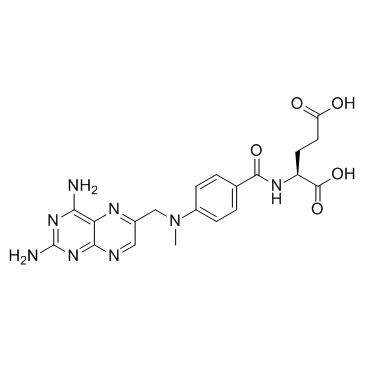
Methotrexate structure
|
Common Name | Methotrexate | ||
|---|---|---|---|---|
| CAS Number | 59-05-2 | Molecular Weight | 454.439 | |
| Density | 1.4080 | Boiling Point | 561.26°C | |
| Molecular Formula | C20H22N8O5 | Melting Point | 195°C | |
| MSDS | Chinese USA | Flash Point | 11℃ | |
| Symbol |


GHS06, GHS08 |
Signal Word | Danger | |
Use of MethotrexateMethotrexate is a folate antagonist, with median IC50 of 78 nM in in vitro assay. |
This table lists Chinese names, IUPAC names and various aliases of this chemical substance.
| Name | methotrexate |
|---|---|
| Synonym | More Synonyms |
This table contains bioactivity, target information and biological‑assay experimental data of this compound.
| Description | Methotrexate is a folate antagonist, with median IC50 of 78 nM in in vitro assay. |
|---|---|
| Related Catalog | |
| Target |
Antifolate[1] |
| In Vitro | Methotrexate (MTX), which has a more predictable toxicity profile than aminopterin, has become a cornerstone of the treatment for childhood acute lymphoblastic leukemia (ALL) and for non-Hodgkins lymphoma[1]. |
| In Vivo | Methotrexate (MTX) exposure reduces thymus and spleen indices of mice. Methotrexate markedly decreases white blood cells, thymic and splenic lymphocytes at dose ≥5 mg/kg. However, there is a significant difference between the treatment plus control group and the model group (p<0.01). The combination of grape seed proanthocyanidins and Siberian ginseng eleutherosides obviously diminishes the effects of Methotrexate exposure on indices of thymus and spleens in mice[2]. |
| Cell Assay | Each cell line is studied in growth inhibition experiments using 96-well microtiter plates. As antifols are schedule dependent, preliminary experiments are aimed at defining the longest duration of exposure that would allow for continuous logarithmic phase growth of cells without changing of the culture media while maintaining a linear relationship between SRB optical density and cell number. Twenty-four hours after cell plating, the cell lines are exposed to the antifol for 120 h (three replicates per experiment). To ensure that a complete sigmoidal survival-concentration curve could be observed, the following drug concentrations are studied: Methotrexate (0.002-5 μM), AMT (0.0001-1 μM), PXD (0.0003-10 μM), TLX (0.0002-0.5 μM). Experiments are repeated at least twice[1]. |
| Animal Admin | Mice[2] The combination of bioactive phytochemicals is administered one week prior to the Methotrexate exposure. Treatment group I: mice are given a combination of green tea polyphenols and eleutherosides from Siberian ginseng (0.2 mL/10 g, i.g. once daily) for 15 days, and a single dose of Methotrexate (2 mg/kg, i.p. once daily) is added on the 8th day. Treatment group II: mice are given a combination of grape seed proanthocyanidins and eleutherosides from Siberian ginseng for 15 days, and Methotrexate is administered on the 8th day in a similar manner. Model group: animals received distilled water instead of bioactive phytochemicals combinations for 15 days and the same Methotrexate protocol applied to this group on the 8th day. Control group: mice are given distilled water through 15 days and physiological saline instead of Methotrexate is administered on the 8th day in a similar manner. Twelve hours after the final doses, the animals are euthanized by cervical dislocation. |
| References |
This table shows physicochemical parameters including melting point, boiling point, density, solubility and optical rotation. Missing data is marked as N/A.
| Density | 1.4080 |
|---|---|
| Boiling Point | 561.26°C |
| Melting Point | 195°C |
| Molecular Formula | C20H22N8O5 |
| Molecular Weight | 454.439 |
| Flash Point | 11℃ |
| Exact Mass | 454.171326 |
| PSA | 210.54000 |
| LogP | -0.24 |
| Index of Refraction | 1.6910 |
| InChIKey | FBOZXECLQNJBKD-ZDUSSCGKSA-N |
| SMILES | CN(Cc1cnc2nc(N)nc(N)c2n1)c1ccc(C(=O)NC(CCC(=O)O)C(=O)O)cc1 |
| Storage condition | Keep in dark place,Inert atmosphere,Store in freezer, under -20°C |
| Stability | Stable, but light sensitive and hygroscopic. Incompatible with strong acids, strong oxidizing agents. Store at -15C or below. |
| Water Solubility | Insoluble. <0.1 g/100 mL at 19 ºC |
This table provides MSDS information including hazard classification, first‑aid, fire‑fighting, spill handling, operation and storage instructions.
This table summarizes toxicological test data, acute & chronic toxicity and ecological hazard parameters for this chemical.
CHEMICAL IDENTIFICATION
HEALTH HAZARD DATAACUTE TOXICITY DATA
MUTATION DATA
|
This table covers safety warnings, protective measures, incompatible substances and disposal guidelines for this compound.
| Symbol |
GHS06, GHS08 |
|---|---|
| Signal Word | Danger |
| Hazard Statements | H301-H315-H319-H340-H360 |
| Precautionary Statements | P201-P280-P301 + P310 + P330-P305 + P351 + P338-P308 + P313-P337 + P313 |
| Hazard Codes | T:Toxic |
| Risk Phrases | R61;R25;R36/38 |
| Safety Phrases | S53-S26-S36/37-S45 |
| RIDADR | UN 2811 6.1/PG 3 |
| WGK Germany | 3 |
| RTECS | MA1225000 |
| Packaging Group | III |
| Hazard Class | 6.1(b) |
| HS Code | 2933990090 |
This table presents publicly reported synthetic routes, reaction conditions, reactants and product information of the compound.
This table lists upstream starting materials and downstream derivative products related to this chemical.
| Precursor 9 | |
|---|---|
| DownStream 8 | |
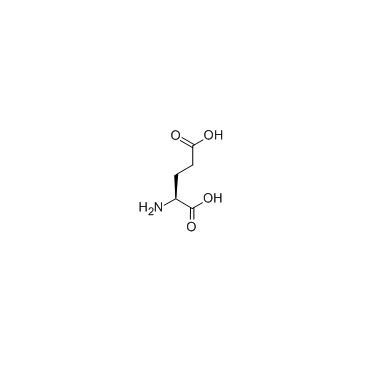 CAS#:56-86-0
![4-{[N-[(2,4-diamino-6-pteridinyl)methyl]-N-methyl]amino}benzoyl azide Structure](https://image.chemsrc.com/caspic/445/56892-87-6.png) CAS#:56892-87-6
CAS#:56892-87-6![3-[3-((allyloxy)carbonyl)-5-oxo-1,3-oxazolan-4-yl]propanoic acid Structure](https://image.chemsrc.com/caspic/069/138965-46-5.png) CAS#:138965-46-5
CAS#:138965-46-5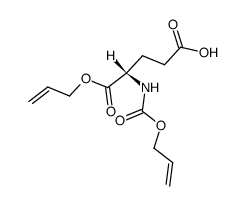 CAS#:91871-28-2
![Diethyl N-[4-(methylamino)benzoyl]-L-glutamate Structure](https://image.chemsrc.com/caspic/000/2378-95-2.png) CAS#:2378-95-2
CAS#:2378-95-2 CAS#:7732-18-5
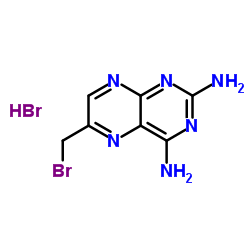 CAS#:52853-40-4
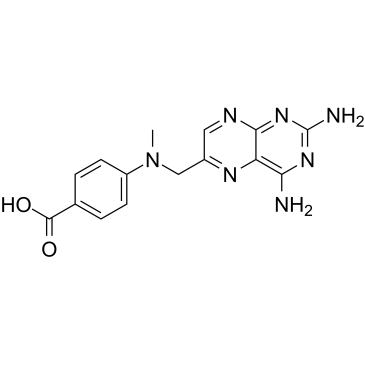 CAS#:19741-14-1
![ditert-butyl 2-[[4-[(2,4-diaminopteridin-6-yl)methyl-methyl-amino]benzoyl]amino]pentanedioate Structure](https://image.chemsrc.com/caspic/063/86669-33-2.png) CAS#:86669-33-2
CAS#:86669-33-2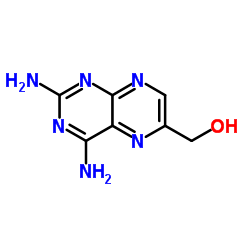 CAS#:945-24-4
![N-[4-(Methylamino)benzoyl]-L-glutamic Acid structure](https://image.chemsrc.com/caspic/434/52980-68-4.png) CAS#:52980-68-4
CAS#:52980-68-4![2-[[4-[(2-Amino-4-Oxo-1H-Pteridin-6-Yl)Methyl-Methylamino]Benzoyl]Amino]Pentanedioic Acid structure](https://image.chemsrc.com/caspic/124/2410-93-7.png) CAS#:2410-93-7
CAS#:2410-93-7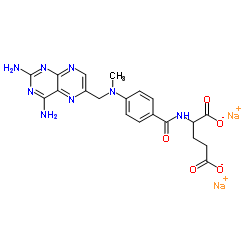 CAS#:7413-34-5
![(2S)-2-[[3-bromo-4-[(2,4-diaminopteridin-6-yl)methyl-methyl-amino]benzoyl]amino]pentanedioic acid structure](https://image.chemsrc.com/caspic/237/13082-83-2.png) CAS#:13082-83-2
CAS#:13082-83-2![bis[(6-chlorobenzo[1,3]dioxol-5-yl)methyl] 2-[[4-[(2,4-diaminopteridin-6-yl)methyl-methyl-amino]benzoyl]amino]pentanedioate structure](https://image.chemsrc.com/caspic/145/86688-51-9.png) CAS#:86688-51-9
CAS#:86688-51-9![1-[(4-{[(2,4-Diaminopteridin-6-yl)methyl]methylamino}-5-bromo-3-chlorophenyl)carbonylamino]propane-1,3-dicarboxylic acid structure](https://image.chemsrc.com/caspic/256/6914-12-1.png) CAS#:6914-12-1
CAS#:6914-12-1This table shows customs‑related data including HS‑code, tariff and regulatory conditions for import and export.
| HS Code | 2933990090 |
|---|---|
| Summary | 2933990090. heterocyclic compounds with nitrogen hetero-atom(s) only. VAT:17.0%. Tax rebate rate:13.0%. . MFN tariff:6.5%. General tariff:20.0% |
This table lists relevant public references with title, journal and publication metadata for this compound.
|
Retinoic acid synergizes ATO-mediated cytotoxicity by precluding Nrf2 activity in AML cells.
Br. J. Cancer 111(5) , 874-82, (2014) Standard therapy for acute promyelocytic leukaemia (APL) includes retinoic acid (all-trans retinoic acid (ATRA)), which promotes differentiation of promyelocytic blasts. Although co-administration of ... |
|
|
Cleavage efficient 2A peptides for high level monoclonal antibody expression in CHO cells.
MAbs 7(2) , 403-12, (2015) Linking the heavy chain (HC) and light chain (LC) genes required for monoclonal antibodies (mAb) production on a single cassette using 2A peptides allows control of LC and HC ratio and reduces non-exp... |
|
|
TLR signaling modulates side effects of anticancer therapy in the small intestine.
J. Immunol. 194(4) , 1983-95, (2015) Intestinal mucositis represents the most common complication of intensive chemotherapy, which has a severe adverse impact on quality of life of cancer patients. However, the precise pathophysiology re... |
This table collects all English aliases, systematic names and CAS‑related synonyms of the compound.
| R 9985 |
| MFCD00064370 |
| EINECS 200-413-8 |
| Amethopterine |
| N-(4-{[(2,4-Diaminopteridin-6-yl)methyl](methyl)amino}benzoyl)-L-glutamic acid |
| N-(4-{[(2,4-Diamino-6-pteridinyl)methyl](methyl)amino}benzoyl)-L-glutamic acid |
| (2S)-2-{[(4-{[(2,4-diaminopteridin-6-yl)methyl](methyl)amino}phenyl)carbonyl]amino}pentanedioic acid |
| X 133 |
| L-Amethopterin |
| TCMDC-125858 |
| MTX |
| Hdmtx |
| α-Methopterin |
| L-A-methopterin |
| (+)-Amethopterin |
| 4-Amino-N10-methylfolic Acid |
| 4-amino-4-deoxy-10-methylpteroyl-L-glutamic acid |
| Methotrexate |
| L-(+)-N-[p-[[(2,4-Diamino-6-pteridinyl)methyl]methylamino]benzoyl]glutamic Acid |
| L-Methotrexate |
| Mexate |
| 4-Amino-N10-methylpteroylglutamic Acid |
This section contains frequently‑asked‑questions about this compound, including basic parameters, properties, storage conditions and corresponding answers.
| Q: What is the CAS number of methotrexate? |
| A: CAS number of methotrexate is 59-05-2. |
| Q: What is the InChIKey of methotrexate? |
| A: InChIKey of methotrexate is FBOZXECLQNJBKD-ZDUSSCGKSA-N. |
| Q: What are the storage conditions for methotrexate? |
| A: Storage conditions for methotrexate: Keep in dark place,Inert atmosphere,Store in freezer, under -20°C. |
| Q: How is the water solubility of methotrexate? |
| A: Water solubility of methotrexate: Insoluble. <0.1 g/100 mL at 19 ºC. |
| Q: What is the polar surface area (PSA) of methotrexate? |
| A: Polar surface area (PSA) of methotrexate is 210.54000. |
| Q: What are the uses of methotrexate? |
| A: Main uses of methotrexate: Methotrexate is a folate antagonist, with median IC50 of 78 nM in in vitro assay. |
| Q: What is the melting point of methotrexate? |
| A: Melting point of methotrexate is 195°C. |
| Q: What is the molecular weight of methotrexate? |
| A: Molecular weight of methotrexate is 454.439. |
| Q: What is the boiling point of methotrexate? |
| A: Boiling point of methotrexate is 561.26°C. |
| Q: What is the LogP of methotrexate? |
| A: LogP of methotrexate is -0.24. |
This table lists manufacturers and suppliers of this compound, including vendor names and product supply reference information.
| Dayang Chem (Hangzhou) Co., Ltd. |
| Henan Tianfu Chemical Co., Ltd. |