4-Chlorobenzene-1,2-diamine
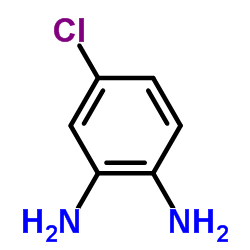
4-Chlorobenzene-1,2-diamine structure
|
Common Name | 4-Chlorobenzene-1,2-diamine | ||
|---|---|---|---|---|
| CAS Number | 95-83-0 | Molecular Weight | 142.586 | |
| Density | 1.3±0.1 g/cm3 | Boiling Point | 300.2±22.0 °C at 760 mmHg | |
| Molecular Formula | C6H7ClN2 | Melting Point | 70-73 °C(lit.) | |
| MSDS | Chinese USA | Flash Point | 135.4±22.3 °C | |
| Symbol |


GHS07, GHS08 |
Signal Word | Warning | |
|
Development of QSAR models for predicting hepatocarcinogenic toxicity of chemicals.
Eur. J. Med. Chem. 44 , 3658-64, (2009) A dataset comprising 55 chemicals with hepatocarcinogenic potency indices was collected from the Carcinogenic Potency Database with the aim of developing QSAR models enabling prediction of the above unwanted property for New Chemical Entities. The dataset was... |
|
|
4-Chloro-ortho-phenylenediamine and 4-chloro-meta-phenylenediamine.
IARC Monogr. Eval. Carcinog. Risk Chem. Hum. 27 , 81-9, (1982)
|
|
|
Carcinogenicity of 4-chloro-o-phenylenediamine, 4-chloro-m-phenylenediamine, and 2-chloro-p-phenylenediamine in Fischer 344 rats and B6C3F1 mice.
Carcinogenesis 1(6) , 495-9, (1980) In both male and female Fischer rats, feeding 4-chloro-o-phenylenediamine at 0.5 or 1% in the diet led to a significant increase in hyperplasia, papilloma and carcinoma of the urinary bladder. Neoplastic nodules of the liver and squamous cell papillomas of th... |
|
|
Evaluation of the in vivo genotoxic potential of three carcinogenic aromatic amines using the Big Blue transgenic mouse mutation assay.
Environ. Mol. Mutagen. 28(4) , 354-62, (1996) Three genotoxic mouse carcinogens, 4-chloro-o-phenylenediamine (4-C-o-PDA), 2-nitro-p-phenylenediamine (2-N-p-PDA), and 2,4-diaminotoluene (2,4-DAT), were tested in the Big Blue transgenic mouse mutation assay. Each experiment consisted of a vehicle control g... |
|
|
4-Chloro-o-phenylenediamine.
Rep. Carcinog. 12 , 101-2, (2011)
|
|
|
4-Chloro-o-phenylenediamine.
Rep. Carcinog. 11 , III58-9, (2004)
|
|
|
4-Chloro-o-phenylenediamine.
Rep. Carcinog. 10 , 59, (2002)
|
|
|
Acute D-serine treatment produces antidepressant-like effects in rodents.
Int. J. Neuropsychopharmacol. 15(8) , 1135-48, (2012) Research suggests that dysfunctional glutamatergic signalling may contribute to depression, a debilitating mood disorder affecting millions of individuals worldwide. Ketamine, a N-methyl-D-aspartate (NMDA) receptor antagonist, exerts rapid antidepressant effe... |
|
|
Studies on three structurally related phenylenediamines with the mouse micronucleus assay system.
Mutat. Res. 259(1) , 43-8, (1991) Three structurally related compounds, 4-chloro-o-phenylenediamine (COP), 4-nitro-o-phenylenediamine (NOP) and p-phenylenediamine dihydrochloride (PPD), are used in fur dyes, inks and hair coloring formulations. COP has been reported to be carcinogenic in both... |
|
|
Assays of three carcinogen/non-carcinogen chemical pairs for in vivo induction of chromosome aberrations, sister chromatid exchanges and micronuclei.
Environ. Mol. Mutagen. 14(4) , 207-20, (1989) Three pairs of structurally similar carcinogenic/non-carcinogenic chemicals were tested for in vivo genotoxic activity in B6C3F1 mice. The carcinogenic/non-carcinogenic pairs, respectively, were o-toluidine hydrochloride/o-anthranilic acid, 4-chloro-o-phenyle... |