120-46-7
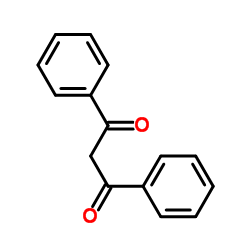
120-46-7 structure
- Name: 1,3-Diphenylpropane-1,3-dione
- Chemical Name: dibenzoylmethane
- CAS Number: 120-46-7
- Molecular Formula: C15H12O2
- Molecular Weight: 224.255
- Catalog: Chemical reagent Organic reagent Aromatic ketone
- Create Date: 2018-07-22 16:56:38
- Modify Date: 2026-07-03 19:27:06
-
Dibenzoylmethane, a minor ingredient in licorice, activates Nrf2 and prevents various cancers and oxidative damage. Dibenzoylmethane, an analog of curcumin, results in dissociation from Keap1 and nuclear translocation of Nrf2[1].
| Name | dibenzoylmethane |
|---|---|
| Synonyms |
1,3-Diphenyl-1,3-propanedione
1,3-DIPHENYL-1,3-PROPANEDIONE 1,3-diphenylpropane-1,3-dione Benzoylace-tophenone Dibenzoylmethan phenacyl phenyl ketone enzu dk 2 kenzudk2 DIBENZOYLMMETHANE & (Z)-3-hydroxy-1,3-diphenyl-2-propen-1-one ibenzoylmethane DibenzoylMethane, R Kenz DK 2 Hydroxy-chalkone Benzoylacetophenone DBM83 dppd-h 1,3-Diphenyl-1,3-propanedione,Dibenzoylmethane rhodiastab83 2-Benzoylacetophenone omega-Benzoylacetophenone DibenzoylMethane (DBM) 1,3-Diphenyl-1,3-propanediamine Phenyl-hydroxystyrylketone 3-Diphenyl-propane-1,3-dione 1,3-DIPHENYL-1,3-PROPANEDIONE FOR SYNTHE 1,3-Propanedione, 1,3-diphenyl 1,3-Diphenyl-1,3-propanedione > 1,3-Diphenyl-1,3-propanedione~Dppd-H 3-Propanedione,1,3-diphenyl-1 hodiastab 83 2-Aminoacetophenone -9 phenylphenacylketone Dibenzoylmethane MFCD00003085 Dibenzoylmethane,1,3-Diphenyl-1,3-propanedione EINECS 204-398-9 1,3-diphenyl-3-propanedione Phenyl phenacyl ketone Dibenzoylmethane in stock Factory TIANFU-CHEM Dibenzoylmethane 1,3-Diphenylpropanedione Phenacyl phenyl ketone DIBENZOYLMETHANE extrapure |
| Description | Dibenzoylmethane, a minor ingredient in licorice, activates Nrf2 and prevents various cancers and oxidative damage. Dibenzoylmethane, an analog of curcumin, results in dissociation from Keap1 and nuclear translocation of Nrf2[1]. |
|---|---|
| Related Catalog | |
| In Vitro | Dibenzoylmethane (10, 20, 30, 40, 50 μM; 6 hours) treatment concentration-dependently increases the mRNA level of HO-1 but has no effect on the mRNA level of Nrf2 in HepG2 cells. Dibenzoylmethane induces HO-1 and Nrf2 protein expression, and the induction diminishes after 12 h[1]. Dibenzoylmethane (10, 20, 30, 40, 50 μM; 2 hours) concentration-dependently increases the phosphorylated protein levels of Erk1/2, p38MAPK, JNK, AMPK, and Akt in HepG2 cells.Dibenzoylmethane does not show significant cytotoxicity[1]. |
| In Vivo | Dibenzoylmethane (200, 500 mg/kg/day; ip; for three consecutive days) pretreatment significantly reduces both the area and the severity of necrosis, as well as the leukocyte infiltration, at a dose of 200 mg/kg in wild-type and Nrf2 knockout mice[1]. Dibenzoylmethane protectes against CCl4-induced (1:49,v/v, 10 ml/kg) liver damage in wild-type mice[1]. |
| References |
| Density | 1.1±0.1 g/cm3 |
|---|---|
| Boiling Point | 357.4±0.0 °C at 760 mmHg |
| Melting Point | 77-79 °C(lit.) |
| Molecular Formula | C15H12O2 |
| Molecular Weight | 224.255 |
| Flash Point | 146.9±20.2 °C |
| Exact Mass | 224.083725 |
| PSA | 34.14000 |
| LogP | 3.04 |
| Vapour Pressure | 0.0±0.8 mmHg at 25°C |
| Index of Refraction | 1.584 |
| Storage condition | Store at RT. |
| Stability | Stable. Incompatible with strong oxidizing agents. |
CHEMICAL IDENTIFICATION
HEALTH HAZARD DATAACUTE TOXICITY DATA
|
| Personal Protective Equipment | Eyeshields;Gloves;type N95 (US);type P1 (EN143) respirator filter |
|---|---|
| Hazard Codes | Xi: Irritant; |
| Risk Phrases | R36/37/38 |
| Safety Phrases | S22-S24/25 |
| RIDADR | NONH for all modes of transport |
| WGK Germany | 3 |
| RTECS | TZ1930000 |
| HS Code | 2914399090 |
| Precursor 10 | |
|---|---|
| DownStream 8 | |



| HS Code | 2914399090 |
|---|---|
| Summary | 2914399090. other aromatic ketones without other oxygen function. VAT:17.0%. Tax rebate rate:13.0%. . MFN tariff:5.5%. General tariff:30.0% |