P-DINITROBENZENE
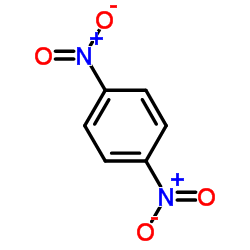
P-DINITROBENZENE structure
|
Common Name | P-DINITROBENZENE | ||
|---|---|---|---|---|
| CAS Number | 100-25-4 | Molecular Weight | 168.107 | |
| Density | 1.5±0.1 g/cm3 | Boiling Point | 299.9±13.0 °C at 760 mmHg | |
| Molecular Formula | C6H4N2O4 | Melting Point | 170-173 °C(lit.) | |
| MSDS | Chinese USA | Flash Point | 154.4±12.6 °C | |
| Symbol |


GHS06, GHS08, GHS09 |
Signal Word | Danger | |
| Name | 1,4-dinitrobenzene |
|---|---|
| Synonym | More Synonyms |
| Density | 1.5±0.1 g/cm3 |
|---|---|
| Boiling Point | 299.9±13.0 °C at 760 mmHg |
| Melting Point | 170-173 °C(lit.) |
| Molecular Formula | C6H4N2O4 |
| Molecular Weight | 168.107 |
| Flash Point | 154.4±12.6 °C |
| Exact Mass | 168.017105 |
| PSA | 91.64000 |
| LogP | 1.37 |
| Vapour Pressure | 0.0±0.6 mmHg at 25°C |
| Index of Refraction | 1.612 |
| InChIKey | FYFDQJRXFWGIBS-UHFFFAOYSA-N |
| SMILES | O=[N+]([O-])c1ccc([N+](=O)[O-])cc1 |
| Stability | Stable, but may be shock-sensitive. May explode if heated. Incompatible with oxidizing agents, strong bases, nitric acid, many metals, tin oxides. |
CHEMICAL IDENTIFICATION
HEALTH HAZARD DATAACUTE TOXICITY DATA
MUTATION DATA
|
| Symbol |
GHS06, GHS08, GHS09 |
|---|---|
| Signal Word | Danger |
| Hazard Statements | H300 + H310 + H330-H373-H410 |
| Precautionary Statements | P260-P264-P273-P280-P284-P301 + P310 |
| Personal Protective Equipment | Eyeshields;Faceshields;full-face particle respirator type N100 (US);Gloves;respirator cartridge type N100 (US);type P1 (EN143) respirator filter;type P3 (EN 143) respirator cartridges |
| Hazard Codes | T+,N |
| Risk Phrases | R26/27/28 |
| Safety Phrases | S28-S36/37-S45-S60-S61 |
| RIDADR | UN 3443 6.1/PG 2 |
| WGK Germany | 3 |
| RTECS | CZ7525000 |
| Packaging Group | II |
| Hazard Class | 6.1 |
| Precursor 10 | |
|---|---|
| DownStream 10 | |
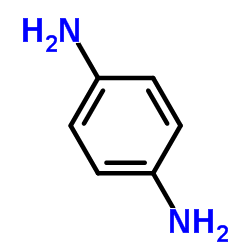 CAS#:106-50-3
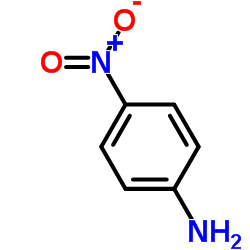 CAS#:100-01-6
 CAS#:71-43-2
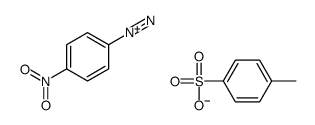 CAS#:1947-33-7
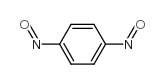 CAS#:105-12-4
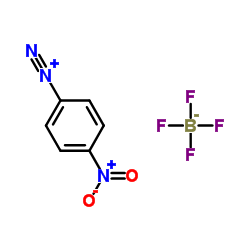 CAS#:456-27-9
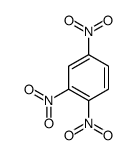 CAS#:610-31-1
 CAS#:4485-08-9
 CAS#:74087-85-7
 CAS#:624-18-0
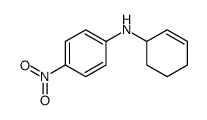 CAS#:110228-57-4
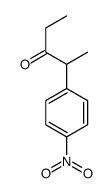 CAS#:104869-86-5
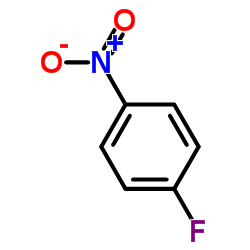 CAS#:350-46-9
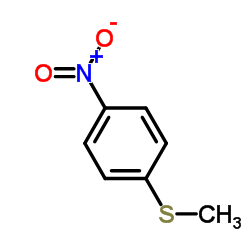 CAS#:701-57-5
![oxybis[4-nitrobenzene] structure](https://image.chemsrc.com/caspic/238/101-63-3.png) CAS#:101-63-3
CAS#:101-63-3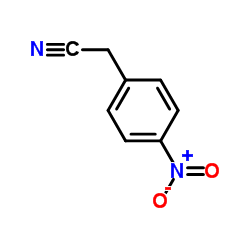 CAS#:555-21-5
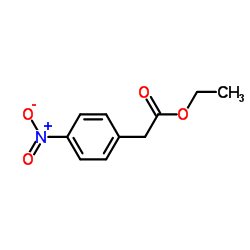 CAS#:5445-26-1
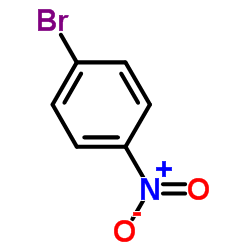 CAS#:586-78-7
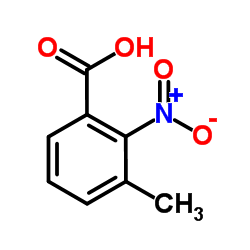 CAS#:5437-38-7
|
Macromolecular Systems with MSA-Capped CdTe and CdTe/ZnS Core/Shell Quantum Dots as Superselective and Ultrasensitive Optical Sensors for Picric Acid Explosive.
ACS Appl. Mater. Interfaces 7 , 24778-90, (2015) This work reports the development of highly fluorescent materials for the selective and efficient detection of picric acid explosive in the nanomolar range by fluorescence quenching phenomenon. Poly(v... |
|
|
Biocompatibility of poly(D,L-lactic-co-hydroxymethyl glycolic acid) microspheres after subcutaneous and subcapsular renal injection.
Int. J. Pharm. 482(1-2) , 99-109, (2015) Poly(D,L-lactic-co-hydroxymethyl glycolic acid) (PLHMGA) is a biodegradable copolymer with potential as a novel carrier in polymeric drug delivery systems. In this study, the biocompatibility of PLHMG... |
|
|
Purity Assessment of Aryltetralin Lactone Lignans by Quantitative 1H Nuclear Magnetic Resonance.
Molecules 20 , 9671-85, (2015) In the present work, a quantitative 1H Nuclear Magnetic Resonance (qHNMR) was established for purity assessment of six aryltetralin lactone lignans. The validation of the method was carried out, inclu... |
| 9,10-Anthracenedione,1,4-dinitro |
| 1,4-Dinitrobenzene |
| MFCD00007314 |
| para-Dinitrobenzene |
| 1,4-Dinitrobenzene-14N,14N |
| 1,4-Dinitro-anthrachinon |
| EINECS 202-833-7 |
| P-DINITROBENZENE |