Verapamil
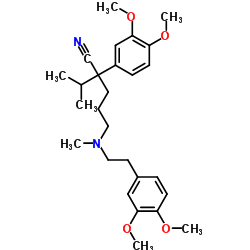
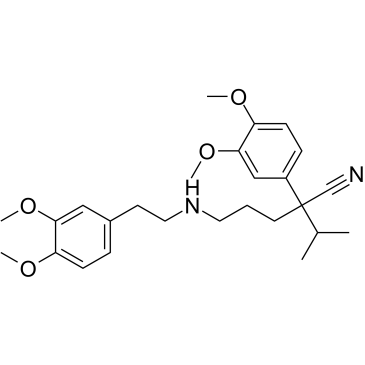
Verapamil structure
|
Common Name | Verapamil | ||
|---|---|---|---|---|
| CAS Number | 52-53-9 | Molecular Weight | 454.602 | |
| Density | 1.1±0.1 g/cm3 | Boiling Point | 586.2±50.0 °C at 760 mmHg | |
| Molecular Formula | C27H38N2O4 | Melting Point | 25°C | |
| MSDS | N/A | Flash Point | 308.3±30.1 °C | |
Use of VerapamilVerapamil ((±)-Verapamil) is a calcium channel blocker and a potent and orally active first-generation P-glycoprotein (P-gp) inhibitor. Verapamil also inhibits CYP3A4. Verapamil has the potential for high blood pressure, heart arrhythmias and angina treatment[1][2][3]. |
This table lists Chinese names, IUPAC names and various aliases of this chemical substance.
| Name | 2-(3,4-dimethoxyphenyl)-5-{[2-(3,4-dimethoxyphenyl)ethyl](methyl)amino}-2-(propan-2-yl)pentanenitrile |
|---|---|
| Synonym | More Synonyms |
This table contains bioactivity, target information and biological‑assay experimental data of this compound.
| Description | Verapamil ((±)-Verapamil) is a calcium channel blocker and a potent and orally active first-generation P-glycoprotein (P-gp) inhibitor. Verapamil also inhibits CYP3A4. Verapamil has the potential for high blood pressure, heart arrhythmias and angina treatment[1][2][3]. |
|---|---|
| Related Catalog | |
| Target |
Calcium channel[1] Permeability-glycoprotein (P-gp)[1] CYP3A4[1] |
| In Vitro | The EverFluor FL Verapamil (EFV) uptake by TR-iBRB2 cells is inhibited by cationic drugs, and inhibits by verapamil in a concentration-dependent manner with an IC50 of 98.0 μM[4]. |
| In Vivo | Intravenous Verapamil is highly effective in the termination of paroxysmal reciprocating atrioventricular tachycardia, whether associated with preexcitation or involving the atrioventricular node alone[2]. Given orally it is useful for the prophylaxis of atrioventricular reentry tachycardia, and also in modulating the atrioventricular nodal response in atrial fibrillation[2]. |
| References |
[2]. Krikler DM. Verapamil in arrhythmia. Br J Clin Pharmacol. 1986;21 Suppl 2:183S-189S. |
This table shows physicochemical parameters including melting point, boiling point, density, solubility and optical rotation. Missing data is marked as N/A.
| Density | 1.1±0.1 g/cm3 |
|---|---|
| Boiling Point | 586.2±50.0 °C at 760 mmHg |
| Melting Point | 25°C |
| Molecular Formula | C27H38N2O4 |
| Molecular Weight | 454.602 |
| Flash Point | 308.3±30.1 °C |
| Exact Mass | 454.283173 |
| PSA | 63.95000 |
| LogP | 3.90 |
| Vapour Pressure | 0.0±1.6 mmHg at 25°C |
| Index of Refraction | 1.526 |
| InChIKey | SGTNSNPWRIOYBX-UHFFFAOYSA-N |
| SMILES | COc1ccc(CCN(C)CCCC(C#N)(c2ccc(OC)c(OC)c2)C(C)C)cc1OC |
This table summarizes toxicological test data, acute & chronic toxicity and ecological hazard parameters for this chemical.
CHEMICAL IDENTIFICATION
HEALTH HAZARD DATAACUTE TOXICITY DATA
|
This table covers safety warnings, protective measures, incompatible substances and disposal guidelines for this compound.
| Hazard Codes | C |
|---|---|
| Risk Phrases | R14:Reacts violently with water. R34:Causes burns. R37:Irritating to the respiratory system. |
| Safety Phrases | S26-S36/37/39-S43-S45 |
| RIDADR | UN 1939 8/PG 2 |
| WGK Germany | 3 |
| Packaging Group | II |
| Hazard Class | 8 |
This table presents publicly reported synthetic routes, reaction conditions, reactants and product information of the compound.
|
~80%
Verapamil CAS#:52-53-9 |
| Literature: Wu, Lingyun; Hartwig, John F. Journal of the American Chemical Society, 2005 , vol. 127, # 45 p. 15824 - 15832 |
|
~%
Verapamil CAS#:52-53-9 |
| Literature: Wu, Lingyun; Hartwig, John F. Journal of the American Chemical Society, 2005 , vol. 127, # 45 p. 15824 - 15832 |
|
~%
Verapamil CAS#:52-53-9 |
| Literature: Wu, Lingyun; Hartwig, John F. Journal of the American Chemical Society, 2005 , vol. 127, # 45 p. 15824 - 15832 |
![2-(3,4-dimethoxyphenyl)-2-(2-[1,3]dioxolan-2-yl-ethyl)-3-methyl-butyronitrile structure](https://image.chemsrc.com/caspic/396/871703-17-2.png)
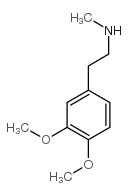
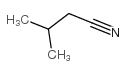
![2-(2-[1,3]dioxolan-2-yl-ethyl)-3-methyl-butyronitrile structure](https://image.chemsrc.com/caspic/236/128776-24-9.png)
This table lists upstream starting materials and downstream derivative products related to this chemical.
| Precursor 4 | |
|---|---|
| DownStream 6 | |
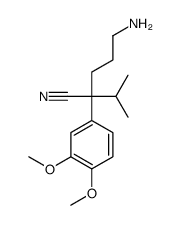 CAS#:27487-66-7
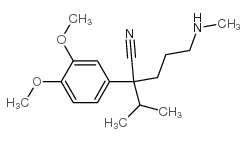 CAS#:34245-14-2
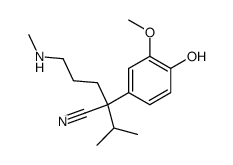
 CAS#:67018-85-3
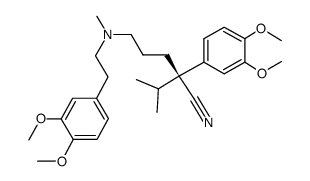
 CAS#:71539-08-7
 CAS#:38321-02-7
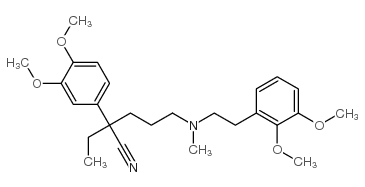 CAS#:36622-29-4
This table collects all English aliases, systematic names and CAS‑related synonyms of the compound.
| eronitrile |
| aleronitrile |
| 2-(3,4-dimethoxyphenyl)-5-{[2-(3,4-dimethoxyphenyl)ethyl](methyl)amino}-2-(propan-2-yl)pentanenitrile |
| EINECS 200-145-1 |
| 5-[(3,4-Dimethoxyphenethyl)methylamino]-2-(3,4-dimethoxyphenyl)-2-isopropylvaleronitrile |
| R,S-Verapamil |
| a-((N-Methyl-N-homoveratryl)-g-aminopropyl)-3,4-dimethoxyphenylacetonitrile |
| Dilacoran |
| VPL |
| Vasolan |
| a-Isopropyl-a-[(N-methyl-N-homoveratryl)-g-aminopropyl]-3,4-dimethoxyphenylacetonitrile |
| Verapamil |
| 2-isopropyl |
| MFCD00056240 |
| (±)-Verapamil |
| D-365 |
| CP 16533-1 |
| 2-(3,4-Dimethoxyphenyl)-5-{[2-(3,4-dimethoxyphenyl)ethyl](methyl)amino}-2-isopropylpentanenitrile |
| dl-Verapamil |
| a-[3-[[2-(3,4-Dimethoxyphenyl)ethyl]methylamino]propyl]-3,4-dimethoxy-a-(1-methylethyl)benzeneacetonitrile |
This section contains frequently‑asked‑questions about this compound, including basic parameters, properties, storage conditions and corresponding answers.
| Q: What is the English name of 2-(3,4-dimethoxyphenyl)-5-{[2-(3,4-dimethoxyphenyl)ethyl](methyl)amino}-2-(propan-2-yl)pentanenitrile? |
| A: The English name of 2-(3,4-dimethoxyphenyl)-5-{[2-(3,4-dimethoxyphenyl)ethyl](methyl)amino}-2-(propan-2-yl)pentanenitrile is 2-(3,4-dimethoxyphenyl)-5-{[2-(3,4-dimethoxyphenyl)ethyl](methyl)amino}-2-(propan-2-yl)pentanenitrile. |
| Q: What is the polar surface area (PSA) of 2-(3,4-dimethoxyphenyl)-5-{[2-(3,4-dimethoxyphenyl)ethyl](methyl)amino}-2-(propan-2-yl)pentanenitrile? |
| A: Polar surface area (PSA) of 2-(3,4-dimethoxyphenyl)-5-{[2-(3,4-dimethoxyphenyl)ethyl](methyl)amino}-2-(propan-2-yl)pentanenitrile is 63.95000. |
| Q: What is the molecular weight of 2-(3,4-dimethoxyphenyl)-5-{[2-(3,4-dimethoxyphenyl)ethyl](methyl)amino}-2-(propan-2-yl)pentanenitrile? |
| A: Molecular weight of 2-(3,4-dimethoxyphenyl)-5-{[2-(3,4-dimethoxyphenyl)ethyl](methyl)amino}-2-(propan-2-yl)pentanenitrile is 454.602. |
| Q: What are the downstream products of 2-(3,4-dimethoxyphenyl)-5-{[2-(3,4-dimethoxyphenyl)ethyl](methyl)amino}-2-(propan-2-yl)pentanenitrile? |
| A: Related downstream products(CAS) of 2-(3,4-dimethoxyphenyl)-5-{[2-(3,4-dimethoxyphenyl)ethyl](methyl)amino}-2-(propan-2-yl)pentanenitrile: 27487-66-7;34245-14-2;67018-85-3;71539-08-7;38321-02-7;36622-29-4. |
| Q: What is the SMILES notation of 2-(3,4-dimethoxyphenyl)-5-{[2-(3,4-dimethoxyphenyl)ethyl](methyl)amino}-2-(propan-2-yl)pentanenitrile? |
| A: SMILES notation of 2-(3,4-dimethoxyphenyl)-5-{[2-(3,4-dimethoxyphenyl)ethyl](methyl)amino}-2-(propan-2-yl)pentanenitrile is COc1ccc(CCN(C)CCCC(C#N)(c2ccc(OC)c(OC)c2)C(C)C)cc1OC. |
| Q: What are the uses of 2-(3,4-dimethoxyphenyl)-5-{[2-(3,4-dimethoxyphenyl)ethyl](methyl)amino}-2-(propan-2-yl)pentanenitrile? |
| A: Main uses of 2-(3,4-dimethoxyphenyl)-5-{[2-(3,4-dimethoxyphenyl)ethyl](methyl)amino}-2-(propan-2-yl)pentanenitrile: Verapamil ((±)-Verapamil) is a calcium channel blocker and a potent and orally active first-generation P-glycoprotein (P-gp) inhibitor. Verapamil also inhibits CYP3A4. Verapamil has the potential for high blood pressure, heart arrhythmias and angina treatment[1][2][3]. |
| Q: What is the melting point of 2-(3,4-dimethoxyphenyl)-5-{[2-(3,4-dimethoxyphenyl)ethyl](methyl)amino}-2-(propan-2-yl)pentanenitrile? |
| A: Melting point of 2-(3,4-dimethoxyphenyl)-5-{[2-(3,4-dimethoxyphenyl)ethyl](methyl)amino}-2-(propan-2-yl)pentanenitrile is 25°C. |
| Q: What is the CAS number of 2-(3,4-dimethoxyphenyl)-5-{[2-(3,4-dimethoxyphenyl)ethyl](methyl)amino}-2-(propan-2-yl)pentanenitrile? |
| A: CAS number of 2-(3,4-dimethoxyphenyl)-5-{[2-(3,4-dimethoxyphenyl)ethyl](methyl)amino}-2-(propan-2-yl)pentanenitrile is 52-53-9. |
| Q: What is the safety information for 2-(3,4-dimethoxyphenyl)-5-{[2-(3,4-dimethoxyphenyl)ethyl](methyl)amino}-2-(propan-2-yl)pentanenitrile? |
| A: Safety information for 2-(3,4-dimethoxyphenyl)-5-{[2-(3,4-dimethoxyphenyl)ethyl](methyl)amino}-2-(propan-2-yl)pentanenitrile: S26-S36/37/39-S43-S45. |
| Q: What is the boiling point of 2-(3,4-dimethoxyphenyl)-5-{[2-(3,4-dimethoxyphenyl)ethyl](methyl)amino}-2-(propan-2-yl)pentanenitrile? |
| A: Boiling point of 2-(3,4-dimethoxyphenyl)-5-{[2-(3,4-dimethoxyphenyl)ethyl](methyl)amino}-2-(propan-2-yl)pentanenitrile is 586.2±50.0 °C at 760 mmHg. |
This table lists manufacturers and suppliers of this compound, including vendor names and product supply reference information.
| Shanghai Nianxing Industrial Co., Ltd |