76584-70-8
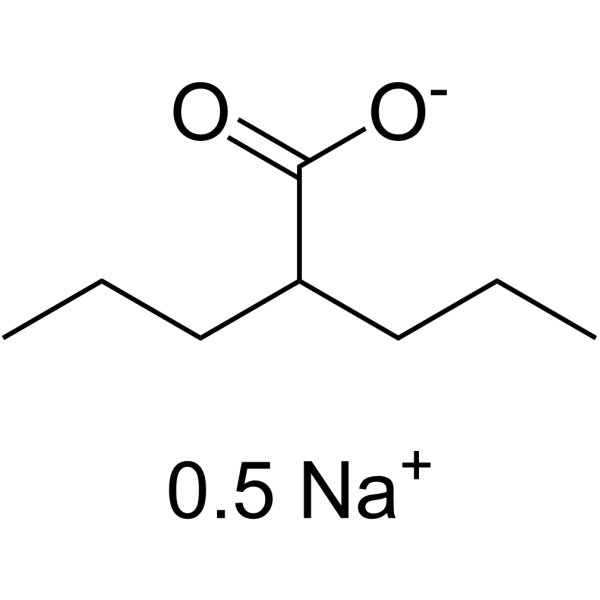
76584-70-8 structure
- Name: Divalproex sodium
- Chemical Name: valproate semisodium
- CAS Number: 76584-70-8
- Molecular Formula: C16H31NaO4
- Molecular Weight: 310.405
- Catalog: Biochemical Inhibitor Autophagy lysosome (Autophagy) Autophagy activator
- Create Date: 2018-10-03 11:46:34
- Modify Date: 2026-07-02 07:16:15
-
Valproic acid (VPA) sodium (2:1) is an orally active HDAC inhibitor, with IC50 in the range of 0.5 and 2 mM, also inhibits HDAC1 (IC50, 400 μM), and induces proteasomal degradation of HDAC2. Valproic acid sodium (2:1) activates Notch1 signaling and inhibits proliferation in small cell lung cancer (SCLC) cells. Valproic acid sodium (2:1) is used in the treatment of epilepsy, bipolar disorder, metabolic disease, HIV infection and prevention of migraine headaches[1][2][3][4][5][6][7].
| Name | valproate semisodium |
|---|---|
| Synonyms |
SodiuM Hydrogen Bis(2-propylvalerate)
Valproic acid (sodium)(2:1) Valproate Semisodium(Divalproate sodium, Divalproex sodium) MFCD00879852 Divalproex Sodium, 10 mM in DMSO Valproic Acid Semisodium Salt sodium,2-propylpentanoate,2-propylpentanoic acid Valproate semisodium Divalproex sodiumQ: What is Divalproex sodium Q: What is the CAS Number of Divalproex sodium Q: What is the storage condition of Divalproex sodium Q: What e the applications of Divalproex sodium Pentanoic acid, 2-propyl-, sodiuM salt (2:1) Divalpropex Sodium Divalproex (sodium salt) Sodium hydrogen bis(2-propylpentanoate) SODIUM DIVALPROATE Sodium hydrogen divalproate Sprinkle sodium 2-propylpentanoate - 2-propylpentanoic acid (1:1) Divalproate UNII-644VL95AO6 Sodium salt (2:1) Valcote 76-8 Divalproex sodium 6-8 Semisodium Valproate Divalproex sodiumUsed Divalproex sodium //BP Sodium hydrogen bis(2-propylvalerate) 2-propyl-pentanoic acid, sodium salt (2:1) ival Depakote Pentanoic acid, 2-propyl-, sodium salt (2:1) Sodium divalproate SodiuM Hydrogen Bis(2-propylpentanoate) Raw Material Divalproex Sodium Sodium 2-propylpentanoate 2-propylpentanoic acid Inhibitor valproate semisodium Depakote ER Depakote CP Dipropylacetic acid hemisodium salt Epival Divalproex Sodium Sodium 2-propylpentanoate - 2-propylpentanoic acid (1:1:1) sodium 2-propylpentanoate 2-propylpentanoic acid (1:1) SodiuM Hydrogen Divalproate Delepsine SEMISODIUMVALPROATE |
| Description | Valproic acid (VPA) sodium (2:1) is an orally active HDAC inhibitor, with IC50 in the range of 0.5 and 2 mM, also inhibits HDAC1 (IC50, 400 μM), and induces proteasomal degradation of HDAC2. Valproic acid sodium (2:1) activates Notch1 signaling and inhibits proliferation in small cell lung cancer (SCLC) cells. Valproic acid sodium (2:1) is used in the treatment of epilepsy, bipolar disorder, metabolic disease, HIV infection and prevention of migraine headaches[1][2][3][4][5][6][7]. |
|---|---|
| Related Catalog | |
| Target |
HDAC1:400 μM (IC50) HDAC:0.5-2 mM (IC50) HDAC2 |
| In Vitro | Valproic acid (VPA) (0-15 mM, 24 and 72 h) inhibits Hela cell growth in a dose- and time- dependent manner[1]. Valproic acid (10 mM, 24 h) significantly attenuates the activities of total, cytosol and nuclear HDACs[1]. Valproic acid (0-15 mM, 24 h) induces a G1 phase arrest at 1–3 mM and a G2/M phase arrest at 10 mM, and increases the percentage of sub-G1 cells in HeLa cells. Valproic acid also induces necrosis, apoptosis and lactate dehydrogenase (LDH) release[1]. Valproic acid (0-20 mM, 24 h) activates Tcf/Lef-dependent transcription and synergizes with lithium[2]. Valproic acid (0-5 mM, 0-18 h) increases β-catenin levels in Neuro2A cells[2]. Valproic acid (0-2 mM, 0-24 h) stimulates phosphorylation of AMPK and ACC in hepatocytes[5]. Valproic acid (0-10 mM, 2 days) induces Notch1 signaling and morphologic differentiation, suppresses production of NE tumor markers in SCLC cells[6]. Cell Viability Assay[1] Cell Line: HeLa cells Concentration: 0, 1, 3, 5, 10 and 15 mM Incubation Time: 24 and 72 h Result: HeLa cell growth was dose- and time-dependently decreased with an IC50 of ~10 and 4 mM at 24 and 72 h. Western Blot Analysis[1][2][5] Cell Line: HeLa cells, Neuro2A cells or primary mouse hepatocytes Concentration: 10 mM (HeLa); 0, 2, and 5 mM (Neuro2A); 0.2, 0.4, 0.8, 1.2 and 2 Mm (hepatocytes) Incubation Time: 24 h (HeLa); 0-18 h (Neuro2A); 0-24 h (hepatocytes) Result: Increased the form of acetylated histone 3. Reduced PARP, induced cleavage PARP, and downregulated Bcl-2. Increased β-catenin levels. Increased the phosphorylation of AMPK and ACC. Cell Cycle Analysis[1] Cell Line: HeLa cells Concentration: 0, 1, 3, 5, 10 and 15 mM Incubation Time: 24 h Result: Induced a G1 phase arrest at 1–3 mM, significantly induced a G2/M phase arrest at 10 mM, and increased the percentage of sub-G1 cells in HeLa cells in a dose-dependent manner at 24 h. |
| In Vivo | Valproic acid (VPA) (500 mg/kg; i.p.; daily for 12 days) inhibits tumor angiogenesis in mice transplanted with Kasumi-1 cells[3]. Valproic acid (350 mg/kg; i.p.; once) enhances social behavior in rats[4]. Valproic acid (0.26% (w/v); p.o. via drinking water; 14 days) decreases liver mass, hepatic fat accumulation, and serum glucose in obese mice without hepatotoxicity[5]. Animal Model: Female BALB/c nude mice, Kasumi-1 tumor model[3] Dosage: 500 mg/kg Administration: Intraperitoneal injection, daily for 12 days Result: Inhibited tumor growth and tumor angiogenesis. Inhibited the mRNA and protein expression of VEGF, VEGFR2 and bFGF. Inhibited HDAC activity and increased acetylation of histone H3. Enhanced the accumulation of hyperacetylated histone H3 on VEGF promoters. Animal Model: Timed-pregnant Long Evans rats[4] Dosage: 350 mg/kg Administration: Intraperitoneal injection, once Result: Demonstrated more social investigation and play fighting than control animals. Animal Model: Obese phenotype of ob/ob mice[5] Dosage: 0.26% (w/v) Administration: Oral via drinking water, 14 days Result: Revealed a marked reduction in the accumulation of fats in the liver as compared with the untreated mice, significantly decreased liver mass to body mass, decreased serum triglyceride concentrations, and did not induce hepatotoxicity. |
| References |
| Boiling Point | 220ºC at 760 mmHg |
|---|---|
| Melting Point | 222ºC |
| Molecular Formula | C16H31NaO4 |
| Molecular Weight | 310.405 |
| Flash Point | 116.6ºC |
| Exact Mass | 310.212006 |
| PSA | 77.43000 |
| LogP | 3.24010 |
| Storage condition | Refrigerator |
| Hazard Codes | Xi |
|---|